.svg)
How to Start a Ceramic Coating Business in 2026: Costs, Margins, and Setup
Ceramic coating offers premium pricing and some of the best margins in the appearance industry. Here is a 2026 guide to starting one: realistic startup costs, margins, earning potential, and setup.

.png)
Helping auto shops work smarter and grow.

Ceramic coating is one of the most attractive services to build a business around, because it combines strong demand, premium pricing, and some of the best profit margins in the automotive appearance industry. Whether you are starting fresh or adding coating to an existing detailing operation, it can be a highly profitable move. But it also demands real skill, proper setup, and sound business practices to do well. This guide covers how to start a ceramic coating business in 2026, including realistic startup costs, the margins and earning potential, and what it actually takes to succeed.
Why ceramic coating is such an attractive business
Ceramic coating stands out for its economics. Industry sources describe profit margins on ceramic coating services typically ranging from around sixty to seventy-five percent, making it one of the most profitable services in the auto customization industry, because the material cost is relatively low while the price customers pay is premium. Demand is strong and growing as more vehicle owners understand coatings as a way to protect a significant investment. And if you already run a detailing, tint, or auto body shop, adding ceramic coating is a natural expansion that can dramatically increase revenue by attaching a high-margin service to customers you already serve. Few services combine high margin, strong demand, and easy attachment to existing work as well as coating does.
What it costs to get started
Startup costs for ceramic coating are modest relative to many automotive businesses, though they vary with your setup. Industry training sources put a professional ceramic coating setup at roughly five thousand to fifteen thousand dollars for equipment and supplies, plus workspace rental if you do not already have a facility. The essential equipment includes a paint correction polisher and pad system, quality surface-preparation products, an infrared curing lamp for proper cure, microfiber towels, and the coatings themselves, along with a clean, dust-controlled space to work in, which matters enormously for coating quality. If you already operate a detailing shop, much of the base equipment and space is in place, so adding coating costs considerably less than starting from scratch.
The earning potential
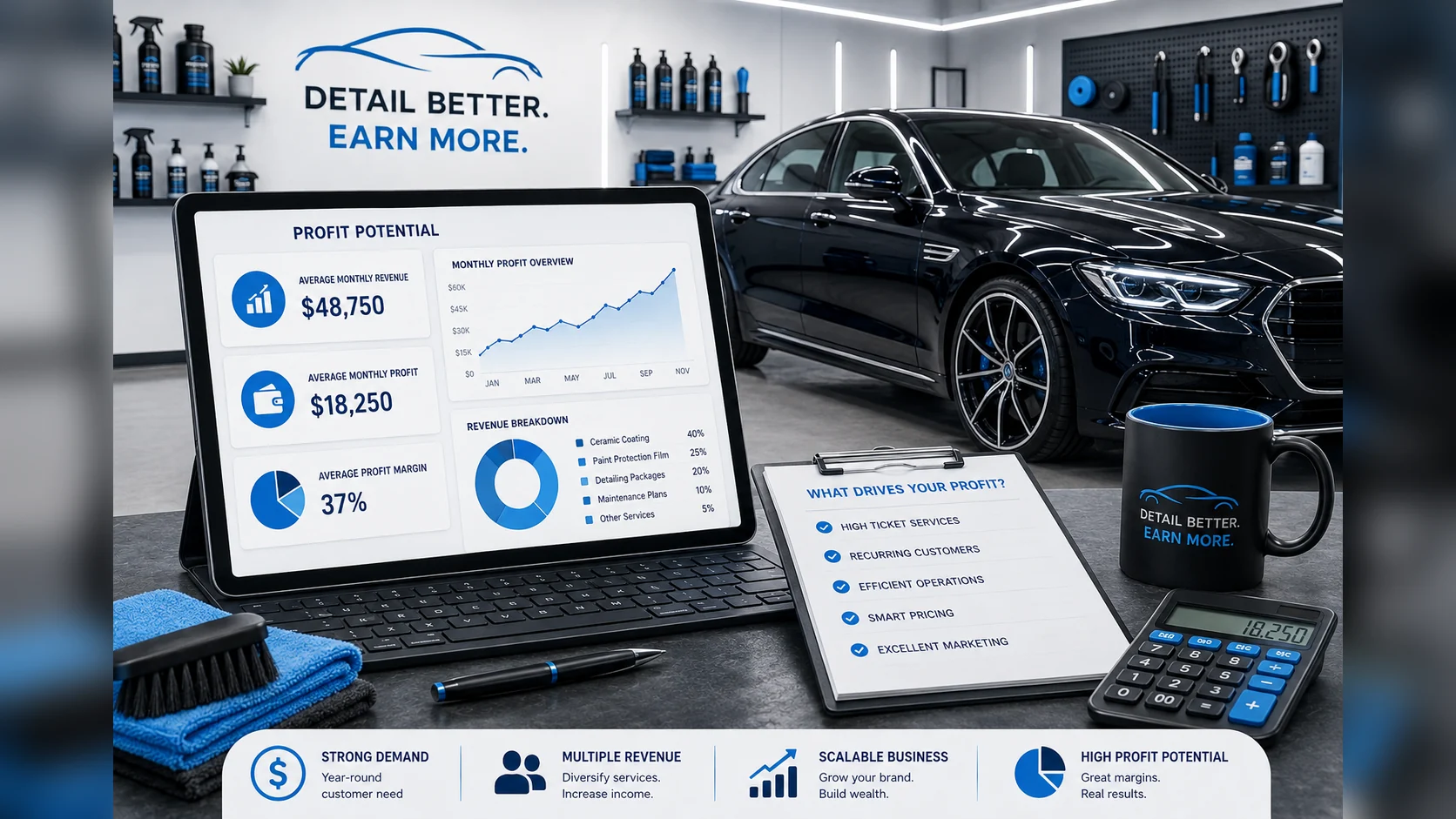
The margins translate into real earning potential. Industry sources note that a single-person ceramic coating operation working on just two to three vehicles per week can generate on the order of one hundred fifty thousand to two hundred fifty thousand dollars in annual revenue, given the premium pricing coating commands. Coating jobs themselves span a wide range depending on the package and vehicle, from entry-level single-year coatings to multi-layer, multi-year systems priced well into four figures, with paint correction often added on top. This combination of high per-job value and healthy margin is what makes ceramic coating so financially appealing, though actual earnings depend heavily on your volume, pricing, skill, and market. Treat these figures as illustrations of the potential, not guarantees.
Skill and quality come first
Ceramic coating is not a service you can offer credibly without real skill, because a coating done on poorly prepared paint or applied incorrectly will fail, and coating failures become expensive, reputation-damaging problems. Proper paint correction before coating, meticulous surface preparation, correct application technique, and a controlled environment all matter enormously. Many successful coating operators invest in training or certification to build these skills and, in some cases, to offer manufacturer-backed coating systems and warranties. Before scaling a coating business, be genuinely confident in your ability to deliver a durable, flawless result every time, because in this service, quality is not just about customer satisfaction, it is about avoiding costly comebacks and protecting the reputation your business depends on.
Set up the business side properly
Like any business, a ceramic coating operation needs sound fundamentals: proper registration, licensing, and insurance, which matters especially because you are working on high-value vehicles where a mistake is costly. Get your pricing right, structured around vehicle size, the level of paint correction required, and the coating package and its durability, so each quote reflects the real work involved. And because coating customers are high-value and their coatings require ongoing maintenance to perform, plan from the start to capture each customer's details, the exact coating applied, and its maintenance schedule, so you can deliver aftercare and repeat business rather than treating each job as one-and-done. The business fundamentals are what turn coating skill into a sustainable, profitable operation.
Build the systems to manage it
Ceramic coating businesses have specific operational needs that reward good systems: tracking exactly which coating was applied to each vehicle and when, managing warranties, scheduling the maintenance and inspections premium coatings require, and following up with high-value customers to protect their investment and earn repeat work. Trying to manage all this on memory and paper leads to missed maintenance, warranty confusion, and lost repeat business, which is expensive given how valuable coating customers are. Keeping each customer's coating and vehicle records, jobs, documentation photos, and maintenance follow-up organized in one system like OXMotive is what lets a coating business protect its warranties and maximize the lifetime value of every high-margin customer. For the customer-facing side, see our guide on ceramic coating maintenance.
How it comes together
Starting a ceramic coating business in 2026 is one of the more financially attractive moves in the appearance industry, with margins commonly cited around sixty to seventy-five percent, modest startup costs of roughly five to fifteen thousand dollars for a professional setup, and strong earning potential even at low weekly volume. But the economics only pay off on a foundation of genuine skill, sound business fundamentals, and organized systems to manage coatings, warranties, maintenance, and high-value customer relationships. Build all three, the craft, the business, and the systems, and ceramic coating can become one of the most profitable services you offer.
Frequently asked questions
How much does it cost to start a ceramic coating business?
Industry training sources put a professional ceramic coating setup at roughly five thousand to fifteen thousand dollars for equipment and supplies, plus workspace rental if you do not already have a facility. Essential equipment includes a paint correction polisher and pads, surface-prep products, an infrared curing lamp, microfiber towels, the coatings, and a clean, dust-controlled workspace. If you already run a detailing shop, much of the base equipment and space is in place, so adding coating costs considerably less.
How profitable is a ceramic coating business?
Very, by industry standards. Sources describe profit margins on ceramic coating services typically ranging from around sixty to seventy-five percent, among the highest in the auto customization industry, because material costs are relatively low while pricing is premium. This high margin, combined with strong demand and the ease of attaching coating to existing detailing customers, is what makes it one of the most financially attractive services to offer.
How much can you make with a ceramic coating business?
Industry sources note that a single-person operation working on just two to three vehicles per week can generate roughly one hundred fifty thousand to two hundred fifty thousand dollars in annual revenue, given coating's premium pricing. Jobs range from entry-level single-year coatings to multi-layer, multi-year systems priced well into four figures, often with paint correction added. Actual earnings depend heavily on volume, pricing, skill, and market, so treat these as illustrations of potential rather than guarantees.
Do I need training or certification to offer ceramic coating?
Skill is essential, because a coating applied on poorly prepared paint or done incorrectly will fail, creating expensive, reputation-damaging problems. Proper paint correction, meticulous prep, correct technique, and a controlled environment all matter greatly. Many successful operators invest in training or certification to build these skills and to offer manufacturer-backed systems and warranties. Be genuinely confident you can deliver a durable, flawless result every time before scaling a coating business.
What do I need to manage a ceramic coating business?
Beyond skill and the usual registration, licensing, and insurance, you need to track which coating was applied to each vehicle and when, manage warranties, schedule the maintenance premium coatings require, and follow up with high-value customers. Managing this on memory and paper leads to missed maintenance, warranty confusion, and lost repeat business. Keeping coating records, jobs, documentation photos, and maintenance follow-up organized in one system protects warranties and maximizes each customer's lifetime value.
[[END FAQ]]
Figures cited reflect published 2026 industry sources and are illustrative, not guarantees. Actual costs, margins, and earnings vary widely by market, skill, and operation. This article is general guidance, not financial, legal, or tax advice, so consult qualified local advisors.
Subscribe to our newsletter today
Fresh insights and practical tips delivered every week.