.svg)
Vehicle Intake Checklist for Detailing & PPF Shops
Use this vehicle intake checklist for detailing shops to document damage, confirm services, capture photos, and avoid costly pickup disputes.

.png)
Helping auto shops work smarter and grow.
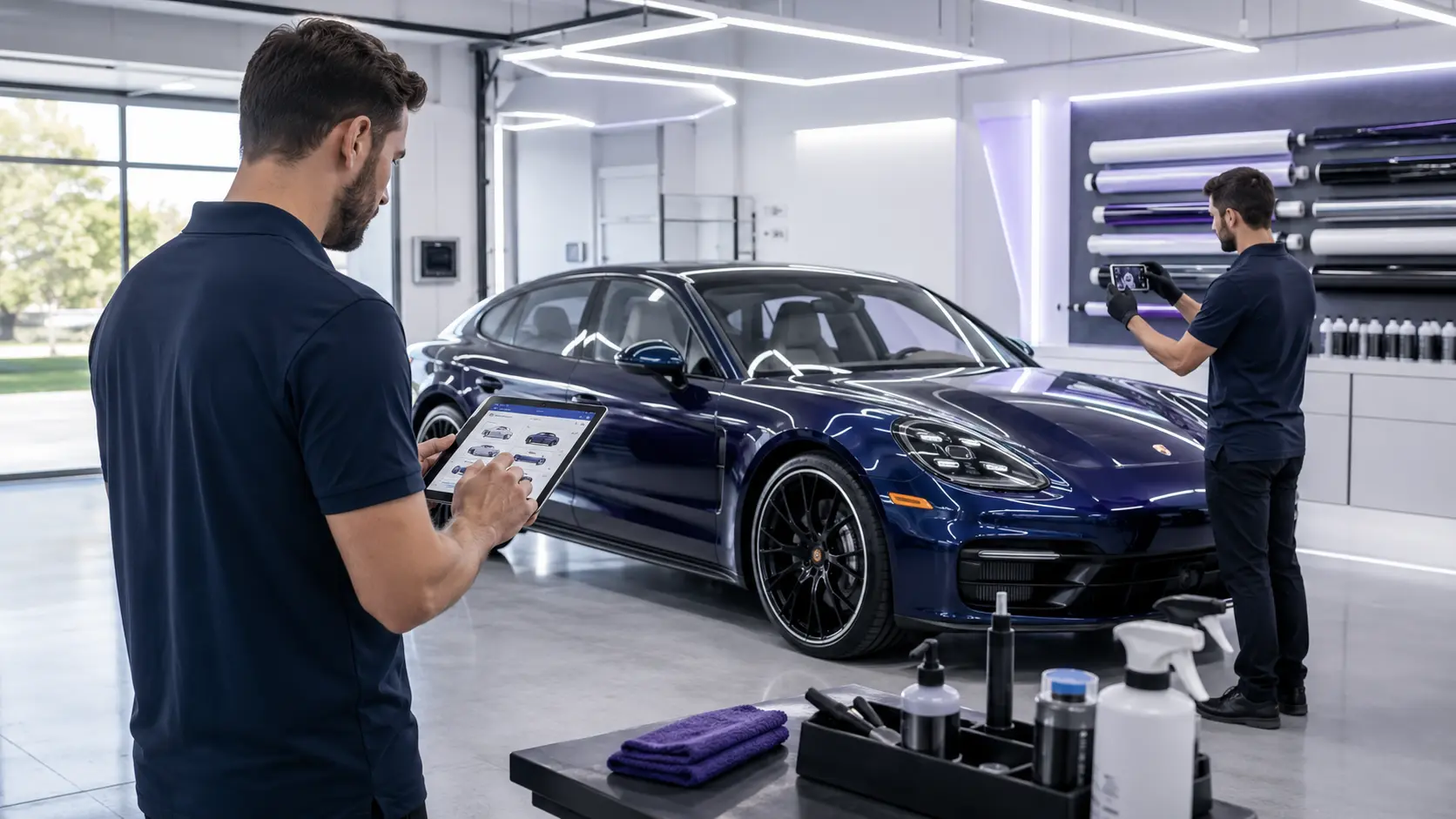
A vehicle can look perfect at first glance and still arrive with a chipped bumper, previously repaired paint, curb rash, loose trim, stained upholstery, aftermarket electronics, or an old section of PPF that changes how your team should approach the job.
That is why a proper vehicle intake process matters.
For detailing, wrap, tint, ceramic coating, and PPF shops, intake is the point where the customer’s expectations become a clear set of instructions for the production team. Done properly, it gives the shop a reliable starting record, helps technicians understand the vehicle before work begins, and makes pickup conversations much easier.
A good vehicle intake checklist should document the customer, vehicle, approved service, existing condition, photos or video, customer concerns, valuables or accessories left inside, keys received, expected completion, and any important limitations before the vehicle enters production.
The goal is not to create more paperwork. The goal is to make sure the vehicle, customer expectations, and job scope are clear before anyone touches the car.
Why Vehicle Intake Matters More Than Most Shops Realize
A weak intake process usually works until something goes wrong.
A customer comes back at pickup and says a scratch was not there before. A technician starts removing vinyl and discovers failing paint underneath it. A wheel already had curb damage, but nobody documented it. A customer expected the entire front end to receive PPF even though the estimate only covered the bumper and partial hood.
None of these situations necessarily means the shop made a mistake.
The real problem is that without a clear intake record, it becomes difficult to establish what the vehicle looked like when it arrived and what the customer actually approved.
For an appearance or protection shop, this is especially important because the work happens directly on the most visible parts of the vehicle. Your team may be working around painted panels, trim, glass, wheels, badges, door edges, upholstery, screens, electronics, aftermarket parts, coatings, wraps, or previously installed film.
The more expensive and invasive the service becomes, the more valuable a proper check-in record becomes.
A $150 maintenance detail may only need a quick inspection. A $6,000 full-body PPF installation deserves a much more detailed record.
The process should scale with the job.
What Should Be Included in a Vehicle Intake Checklist?
The best intake forms are not the longest ones. They are the ones employees actually use.
A useful intake record should answer four basic questions:
Who owns the vehicle? What condition was it in when it arrived? What exactly did the customer approve? What does the production team need to know before starting?
Here is a practical structure.
Intake AreaWhat to RecordWhy It MattersCustomerName, phone, preferred contact methodKeeps communication tied to the correct personVehicleYear, make, model, color, plate, mileage if relevantPrevents confusion between vehiclesServiceExact package, coverage, add-ons, approved workKeeps sales and production alignedExterior ConditionScratches, dents, chips, glass, trim, wheelsEstablishes the vehicle’s starting conditionInterior ConditionSeats, trim, screens, valuables, stains, damageProtects both shop and customerPhotos & VideoWide views plus close-ups of existing damageProvides visual contextAccessoriesKeys, wheel-lock key, removable accessoriesAvoids missing-item confusionCustomer ConcernsSpecific areas the customer wants addressedHelps technicians prioritize correctlyTimingDrop-off time and expected completionPrevents pickup misunderstandingsSpecial NotesRepaint history, previous PPF, wrap, coating, modificationsHelps technicians avoid surprises
The table looks simple, but that is the point.
A strong intake process should be easy enough to complete consistently even when the shop is busy.
Confirm the Exact Service Before the Vehicle Moves Into Production
One of the easiest ways to create a customer dispute is to use vague service descriptions.
“Detailing” is not a useful job instruction.
Neither is “PPF.”
The intake should show exactly what the customer bought.
Instead of writing Full Detail, the record could say:
Interior deep clean, exterior wash, clay treatment, one-step polish, and six-month paint sealant.
Instead of writing PPF, specify:
Full-front PPF including bumper, full hood, full fenders, mirror caps, and headlights.
For a wrap, the record might say:
Full color-change wrap in satin black, excluding door jambs, including badge removal and reinstallation.
This level of detail matters because the person selling the job is not always the person performing it.
A technician should be able to open the job record and understand what was promised without finding the salesperson and asking for clarification.
Shop rule: If another employee cannot understand the job scope by reading the intake record, the scope is not clear enough.
This becomes increasingly important as the shop grows.
A one-person shop can keep a surprising amount of information in the owner’s head. A six-person shop cannot.
Document the Vehicle’s Existing Condition
The walk-around is one of the most valuable parts of intake.
You do not need to perform a full mechanical inspection. You are simply establishing the condition of the areas your team may touch.
Start by looking at the vehicle from a few steps away. Then move closer.
You may notice paint chips, scratches, dents, cracked trim, loose badges, curb rash, windshield chips, damaged tint, peeling clear coat, previous bodywork, torn upholstery, stained seats, damaged screens, or aftermarket accessories.
The important part is not finding every tiny imperfection.
The important part is documenting anything significant enough that it could create confusion later.
If a vehicle arrives with a deep scratch on the passenger door, write it down and photograph it.
If the front bumper has several stone chips and the vehicle is about to receive PPF, document them.
If a trim piece is already loose before a wrap installation, record that.
If paint appears to have been repaired, note it before film removal or polishing begins.
This turns the intake from a casual visual check into a useful reference point for the entire job.
Use Photos as Part of the Record, Not as a Replacement for It
Photos make intake much stronger, but they should support the written record rather than replace it entirely.
A simple photo sequence works well.
Take several wider images that show the entire vehicle from different angles. Then take close-ups of anything unusual.
That gives you both location and detail.
A close-up of a scratch by itself can be difficult to identify later. A wide photo showing the passenger door plus a close-up of the scratch makes the situation much clearer.
For many jobs, you do not need dozens of images.
You need the right images.
Photo TypePurposeBest UseFront 3/4 ViewOverall conditionEvery higher-value jobRear 3/4 ViewOverall conditionEvery higher-value jobDriver SideSide-panel conditionWrap, PPF, correctionPassenger SideSide-panel conditionWrap, PPF, correctionWheelsExisting rash or damageDetailing, coatingWindshield / GlassChips, scratches, previous tintTint, detailingDamage Close-UpDetailed evidenceAny visible pre-existing issueInterior OverviewCabin conditionInterior detailingSpecial AreaCustomer concern or unusual conditionAs needed
This is one area where a mobile workflow makes a major difference.
OxMotive’s Photo & Video Capture feature allows job photos and videos to stay connected to the same customer and job record instead of living inside an employee’s camera roll.
That means intake photos, progress photos, and completion photos can all remain part of the same vehicle history.
Ask the Customer What You Cannot See
A visual inspection only tells you part of the story.
The customer may know things that are not obvious from looking at the car.
This is especially important before wrap removal, PPF removal, paint correction, ceramic coating, tint removal, or any service that interacts directly with the vehicle’s existing surfaces.
A simple conversation can reveal important information.
You may want to ask whether any panels have been repainted, whether the vehicle has had previous PPF or vinyl, whether there are aftermarket electronics or accessories, and whether there is a specific area the customer wants the team to address.
It is also worth asking whether anything valuable or fragile has been left inside the vehicle.
You do not need to interrogate the customer. You are trying to uncover information that may affect the job.
Good intake combines what the shop can see with what the customer already knows.
That small distinction can prevent technicians from discovering important information halfway through the service.
How Intake Should Change Based on the Service
Every vehicle does not need the same inspection.
A useful system changes the intake depth based on the type of work being performed.
ServiceIntake PriorityExtra Information Worth CapturingBasic DetailingExisting damage, interior condition, valuablesCustomer’s problem areasPaint CorrectionPaint condition, chips, repainted panelsPrevious polishing or coatingCeramic CoatingSurface condition, contamination, correction needsExisting coatings or protectionWindow TintGlass condition, existing film, electronicsDefroster and previous tint conditionPPFPaint condition, chips, previous film, exact coverageRepaint history and edge expectationsVehicle WrapPaint, trim, previous vinyl, corrosionFilm choice, design approval, exclusionsInterior DetailSeats, stains, trim, electronicsValuables and customer concerns
This is where many generic intake forms become inefficient.
If every employee is forced to answer 40 questions for every service, employees eventually stop taking the checklist seriously.
The better approach is a short core intake with additional service-specific checks.
PPF Intake Requires More Attention to Paint History
PPF work interacts directly with painted surfaces.
That makes paint history particularly important.
A panel that looks normal may have been repaired or repainted. That does not automatically mean the shop cannot work on it, but the technician should know about it before installation or film removal.
Coverage also needs to be extremely clear.
Customers often use terms such as “front PPF” when they actually mean different things.
One customer may expect the bumper and partial hood.
Another may expect the bumper, full hood, full fenders, mirrors, and headlights.
The intake record should remove that ambiguity.
PPF DetailWhat the Intake Should RecordCoverageExact panels being protectedExisting FilmLocation and current conditionPaint DamageChips, scratches, defectsRepaint HistoryKnown repaired or repainted panelsTrim / BadgesAnything requiring removalCustomer ExpectationsEdge placement, seams, visible boundariesSpecial RisksUnusual paint or surface conditions
That information makes both installation and final delivery much cleaner.
Wrap Shops Need a Stronger Pre-Installation Record
Vehicle wrapping introduces a different set of risks.
The existing paint matters. So does trim condition, corrosion, previous vinyl, adhesive residue, repaired panels, failing clear coat, and customer expectations around coverage.
A wrap can also expose issues that were not obvious before disassembly.
For example, a badge may already have damaged mounting clips. A trim piece may already be loose. A previously repaired panel may react differently during preparation or removal.
This does not mean every wrap job requires a legal document the size of a mortgage agreement.
It means the shop should clearly document unusual conditions before beginning work.
The same applies to the approved design.
The production record should make it obvious which design, color, finish, and coverage the customer approved.
A wrap shop that handles several vehicles at once cannot afford to rely on memory for details this important.
Intake Is Also a Handoff Between Sales and Production
Many shops think of intake only as customer protection.
It is just as valuable internally.
Imagine a salesperson books a ceramic coating package. The customer mentions a deep scratch on the rear quarter panel and asks whether it can be improved.
The salesperson says, “We’ll take a look.”
If that conversation never reaches the technician, the customer may assume the scratch is part of the job while the technician has no idea it was discussed.
That is not necessarily a technical failure.
It is a handoff failure.
A proper job record solves this by keeping customer concerns attached to the job.
OxMotive’s Customer Profiles and Job Management features are useful here because customer details, vehicles, notes, and job status can stay connected rather than being scattered between messages, notebooks, and staff memory.
Build Intake Into the Job Workflow
The easiest checklist to skip is the one that exists outside the actual job process.
Instead of treating intake as optional paperwork, make it part of the job status.
Job StageWhat Should HappenBookedCustomer and service enteredArrivedVehicle physically at shopChecked InIntake complete and condition documentedReady for WorkTechnician can beginIn ProgressProduction underwayQuality CheckFinal inspection before customer contactCompletedService finishedDeliveredVehicle returned to customer
The important transition is between Arrived and Checked In.
Do not move the vehicle into production until the required intake information is complete.
That turns intake into part of the operating system of the shop instead of something employees have to remember separately.
It also makes accountability clearer.
If a vehicle is marked Checked In, everyone on the team should know the photos, notes, and scope have been reviewed.
Who Should Own the Intake Process?
Assign responsibility.
That may be a service advisor, front-desk employee, installer, lead detailer, manager, or owner.
The exact job title does not matter.
Ownership does.
If five employees all assume someone else took the photos, nobody takes the photos.
If everyone assumes the customer already explained the issue, important information gets lost.
The person checking in the vehicle should be responsible for making sure the required intake information exists before production begins.
In larger shops, User Roles & Permissions can help separate who can view, update, or manage different parts of the workflow.
That becomes even more useful when there are multiple service writers, technicians, managers, or locations working in the same system.
What Happens After Intake?
A good intake record should remain useful throughout the job.
The technician should be able to see the approved service, customer concerns, condition notes, photos, and anything unusual before starting.
During production, the team can add progress information.
A wrap installer may notice a damaged clip after removing trim. A detailer may discover a stain beneath a seat that was not visible during intake. A PPF installer may discover evidence of previous paint repair.
Documenting those situations while they happen creates a more complete job history.
That is much better than trying to reconstruct the situation after the customer arrives for pickup.
Intake establishes the starting point. Progress documentation records what happened. Final inspection establishes the ending point.
Those three stages create a much stronger service record.
Do a Second Walk-Around Before Delivery
The intake walk-around should have a matching step at the end.
Before calling the customer, check the vehicle again.
The final inspection should confirm that the approved work is complete and the car is ready to present.
This is also the best time to capture final photos.
Compare the vehicle against the original scope.
Was every area completed? Were badges and trim reinstalled correctly? Are the windows clean? Were customer belongings returned? Are there tools or materials left inside? Does the final result match what the customer purchased?
This does not need to take long.
A disciplined five-minute quality-control walk-around can prevent an avoidable bad pickup experience.
For appearance shops, presentation matters almost as much as production.
A technically strong job can still leave a poor impression if the customer notices dirty glass, fingerprints, loose trim, or missing personal items at pickup.
A Better Intake Process Improves Customer Trust
Most customers never ask to see an intake record.
That does not make it unnecessary.
In fact, a good intake process often builds trust without the customer consciously thinking about it.
The customer sees that your team is paying attention.
You are documenting the vehicle. You are confirming the service. You are asking questions. You are taking photos. You are treating their vehicle like something valuable.
That makes the business feel organized.
And organization matters when customers are handing over a vehicle worth $30,000, $70,000, or $150,000.
The process itself communicates professionalism.
Do Not Let Intake Become Administrative Overload
There is a danger on the other side.
Some shops solve process problems by creating enormous forms.
Then employees stop using them.
The goal should be the minimum amount of information required to run the job correctly.
If a field never changes a decision, protects the customer, helps production, or improves the record, ask whether it is necessary.
A practical system should feel fast.
For a simple detail, intake may take only a couple of minutes.
For a complicated wrap or PPF job, spending ten minutes documenting the vehicle is reasonable because the job may remain in the shop for several days.
The amount of documentation should match the value and complexity of the work.
That is a much better operating principle than using the same giant checklist for every vehicle.
What a Strong Intake System Looks Like in Practice
A strong shop process is not complicated.
The customer arrives and the employee opens the customer’s vehicle record.
The service is confirmed.
The vehicle receives a quick walk-around.
Existing damage is photographed.
Customer concerns are added as notes.
The employee confirms keys and any accessories.
The job moves to Checked In.
The technician opens the same record and starts work.
Progress photos and notes are added if needed.
The job moves through production.
A final inspection is completed.
Completion photos are captured.
The customer receives the vehicle.
Everything stays connected to the same job.
Compare that with a shop where intake photos are in one employee’s phone, customer notes are buried in text messages, appointments live in a separate calendar, job status sits on a whiteboard, and invoices are somewhere else.
That fragmentation creates unnecessary work.
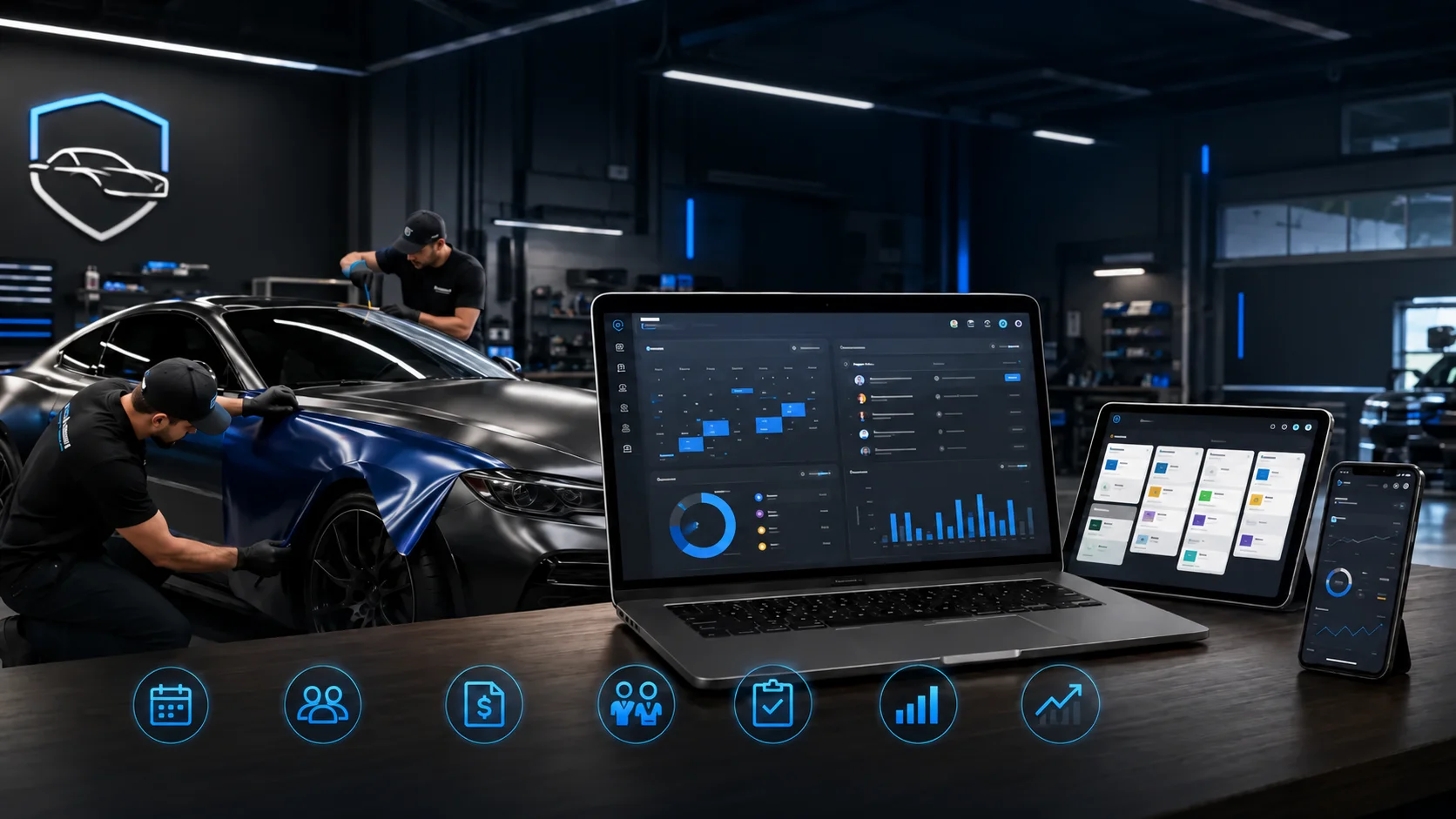
OxMotive is designed around a connected workflow, with Customer Profiles, Job Management, Photo & Video Capture, SMS Updates, Instant Invoicing, and mobile access working together inside one platform.
The benefit is not simply having software.
The benefit is that important information follows the vehicle through the shop.
Frequently Asked Questions
How many intake photos should a detailing shop take?
There is no fixed number that every shop needs. Take enough wide photos to establish the overall vehicle condition, then add close-ups of any existing damage or unusual areas. Higher-value PPF, wrap, ceramic coating, and paint-correction jobs usually justify more documentation.
Should every vehicle receive the same intake process?
No. The core process should stay consistent, but the level of detail should reflect the service. A maintenance detail may require a quick condition record, while a full wrap or PPF installation should include much more detailed paint, coverage, and condition documentation.
Should customers sign the intake record?
For higher-value or higher-risk services, customer acknowledgment of the agreed scope, vehicle condition, and applicable shop terms may be useful. The exact legal wording should be appropriate for your business and location.
Should a wrap or PPF shop record repaint history?
Yes, whenever the customer knows about it or the shop identifies signs of previous repair. Film installation and removal interact directly with painted surfaces, so repaint history can be important information for the technician.
Can mobile detailers use the same intake process?
Yes. Mobile shops still need to confirm the vehicle, service, existing condition, and customer concerns. A mobile-first process can actually make this easier because photos and notes can be recorded directly beside the vehicle.
What is the easiest way to make sure employees complete intake?
Make it part of the job workflow. Require the vehicle to reach a clear Checked In status before production begins, and assign one person responsibility for completing the intake.
[[END FAQ]]
Turn Vehicle Intake Into a Repeatable Shop Process
Vehicle intake should make the shop easier to run, not slower.
The right process gives your team a clear starting record, keeps sales and production aligned, reduces confusion, and gives customers confidence that their vehicle is being handled professionally.
The biggest improvement usually comes from keeping the entire workflow connected.
When customer information, vehicle history, job details, condition photos, notes, updates, and invoices live in the same system, employees spend less time searching for information and more time moving the job forward.
OxMotive brings those pieces together in one platform built specifically for detailing, wrap, tint, PPF, repair, and full-service auto shops.
If your current intake process still depends on paper forms, personal camera rolls, scattered text messages, or staff memory, this is one of the easiest workflows to improve.
Book a Demo with OxMotive or start your 14-day free trial to see how a connected intake and job-management process can work in your shop.
Subscribe to our newsletter today
Fresh insights and practical tips delivered every week.