.svg)
What Belongs in a Customer Record for an Auto Appearance Shop
A name and phone number is not a customer record. Here is what actually belongs in one for an appearance or protection shop, and why each piece earns its place.

.png)
Helping auto shops work smarter and grow.
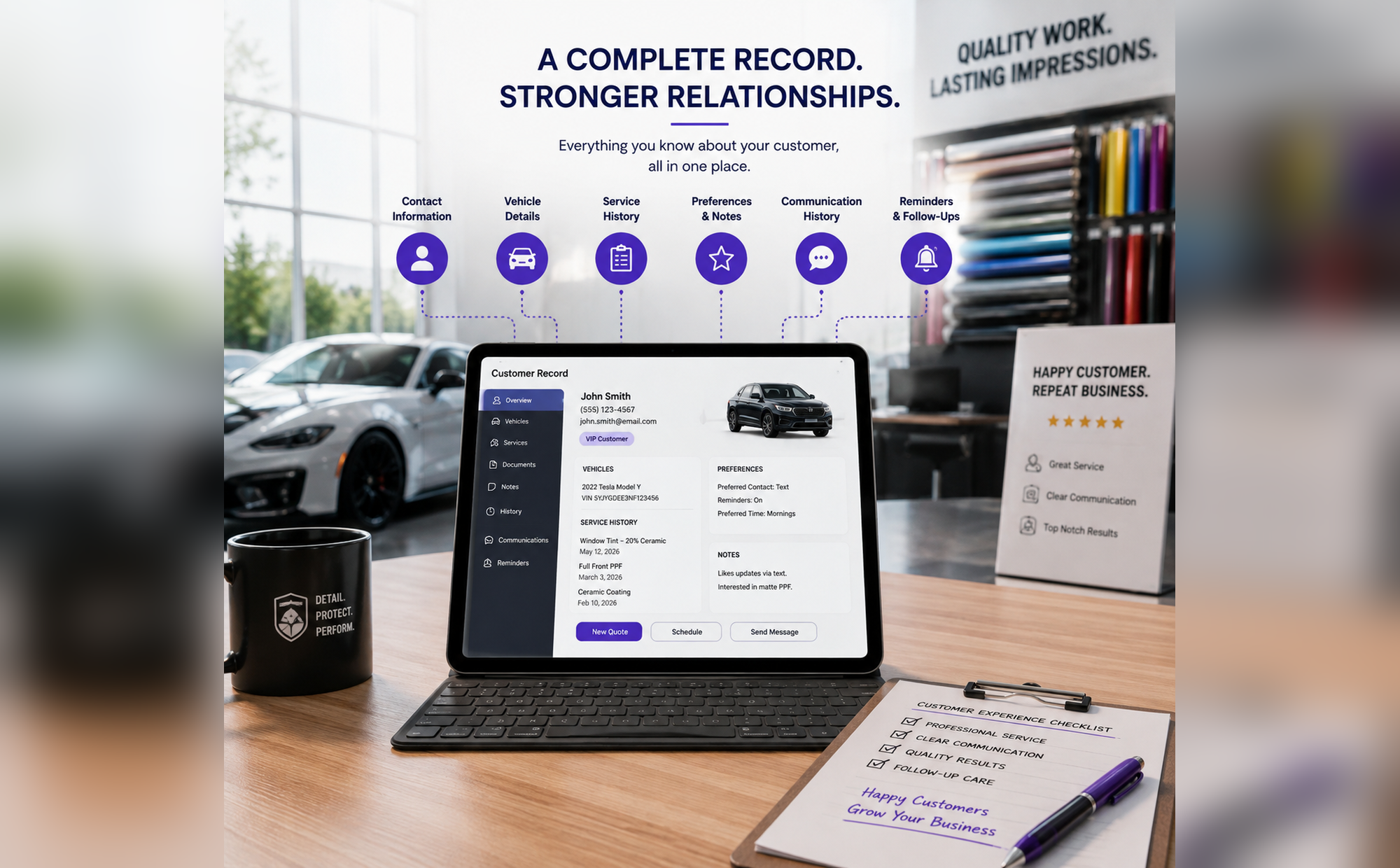
A customer record is only as valuable as what is in it. A name and a phone number tell you almost nothing when that customer comes back a year later. A complete record, the vehicle, the exact work done, the photos, the follow-up due, lets you pick up the relationship as if no time had passed. The difference between those two records is the difference between a business that runs on memory and one that runs on information. This guide covers what actually belongs in a customer record for an appearance or protection shop, and why each piece earns its place.
Contact details and communication preferences
Start with the obvious, but capture it completely. You need the customer's name, phone number, email, and, crucially, how they prefer to be contacted. A customer who wants texts and a customer who wants calls should be treated differently, and knowing that up front makes every future interaction smoother. Recording communication consent matters too, both for respecting the customer and for staying compliant when you send reminders or offers. This is the foundation every other useful action, a reminder, a follow-up, a review request, is built on, so it needs to be accurate and complete rather than a half-filled field on an invoice.
Complete vehicle information
In an appearance shop, the vehicle is central to the work, so its details belong in the record. Capture the year, make, model, color, and any identifier you rely on, along with anything notable about its condition. Detailing, tint, wrap, and coating are all vehicle-specific, and knowing exactly what you are working with, before the customer arrives, lets you prepare, quote accurately, and recommend the right service. A customer may also own more than one vehicle, so the record should connect multiple vehicles to one person. Getting this right is what lets you walk into every job already knowing what you are dealing with.
Full service history
The service history is the heart of a useful record. Every job should be logged with the date, exactly what was performed, what products or coverage were applied, and what was charged. This history protects your pricing by giving you a reference instead of a guess, tells you what a returning customer is due for next, and settles any question about what was done and when. On protection work especially, knowing the coating applied, the film coverage, or the tint installed is essential for warranties and maintenance. A record without service history is just a contact card; the history is what makes it an operating tool.
Photos and visual documentation
Appearance work is visual, so the record should be too. Before-and-after photos and documentation of the vehicle's condition at intake do double duty: they protect you against disputes over pre-existing damage, and they become the marketing content and portfolio that sells your next job. When photos are attached directly to the customer and job rather than lost in a personal camera roll, they stay findable months later when you actually need them, whether to resolve a question, plan maintenance, or show a prospect what your work looks like. For a visual trade, photo documentation is not optional, it is part of the core record.
Notes, preferences, and access details
The small details are what make service feel personal and prevent avoidable problems. A good record captures practical notes: a recurring stain the customer wants watched, a preference for a particular finish, underground parking or access instructions for mobile work, pets, or a sensitivity to certain products. These are the things a customer should not have to explain twice, and remembering them is exactly what turns a competent shop into one a customer feels loyal to. Keep these as genuine notes rather than cluttering the record with routine information, so the important context stands out when staff pull up the profile.
Communication history and follow-up status
Finally, the record should hold the thread of your relationship: what was said, what was promised, and what happens next. Keeping the conversation history attached to the customer means any team member can see what they were told, rather than the customer having to repeat themselves or getting conflicting answers. Just as important is the next action, when they are due for their next service, whether a follow-up or review request has gone out, whether declined work should be revisited. That forward-looking piece is what turns a static archive into a system that actually drives repeat business, because it tells you not just what happened but what to do next.
Keeping it all in one connected record
Individually, each of these pieces is useful. Together, in one connected record, they become powerful, because the vehicle links to the service history, the history links to the photos, and the whole thing links to the follow-up that brings the customer back. That only works when everything lives in one system rather than spread across paper, phones, and memory. Keeping customer and vehicle profiles with photo documentation and history in a single place, updated from the floor as work happens, is what makes the complete record achievable in practice rather than in theory. Capture it as part of the normal workflow and the record builds itself.
How it comes together
A truly useful customer record holds far more than a name: complete contact details and preferences, full vehicle information, a detailed service history, photos, practical notes, and the communication and follow-up thread. Each piece earns its place by making a future interaction faster, more accurate, or more personal, and together they let you serve a returning customer as if they never left. Build records this complete, keep them in one connected system, and you turn every job into lasting, usable knowledge about your business.
Frequently asked questions
What information should a shop keep about each customer?
At minimum: complete contact details and communication preferences, full vehicle information, a detailed service history with dates and products, before-and-after photos, practical notes and access details, and the communication and follow-up thread. Each element earns its place by making a future interaction faster, more accurate, or more personal, turning the record from a contact card into an operating tool.
Why does vehicle information matter so much for appearance shops?
Because the work is vehicle-specific. Detailing, tint, wrap, and coating all depend on knowing exactly what you are working with, so capturing year, make, model, color, condition, and identifier lets you prepare, quote accurately, and recommend the right service before the customer arrives. Connecting multiple vehicles to one customer also ensures nothing is missed for households with more than one car.
Why keep photos in the customer record?
Photos do double duty. Before-and-after and intake-condition images protect you against disputes over pre-existing damage, and they become marketing content and a portfolio that sells future work. Attaching them directly to the customer and job, rather than leaving them in a personal camera roll, keeps them findable months later for warranties, maintenance planning, or showing prospects your work.
What kind of notes are worth recording?
Practical, personal details that a customer should not have to repeat: a recurring stain to watch, a preferred finish, parking or access instructions for mobile jobs, pets, or product sensitivities. Keeping these as genuine notes rather than routine clutter means the important context stands out when staff open the profile, which is what makes service feel personal and builds loyalty.
Why does the follow-up status belong in the record?
Because it turns a static archive into a system that drives repeat business. Recording when a customer is due for their next service, whether a follow-up or review request has gone out, and whether declined work should be revisited tells you not just what happened but what to do next. That forward-looking piece is what systematically brings customers back.
[[END FAQ]]
This article offers general guidance. Collect and store customer information responsibly and in line with applicable privacy laws.
Subscribe to our newsletter today
Fresh insights and practical tips delivered every week.