.svg)
The Four AI Roles Reshaping Automotive Shops: Receptionist, Diagnostics, Estimating, and Marketing
AI is arriving in automotive as four defined roles: receptionist, diagnostician, estimator, and marketer. Here is what each does and the one thing they all require to work: your data.

.png)
Helping auto shops work smarter and grow.
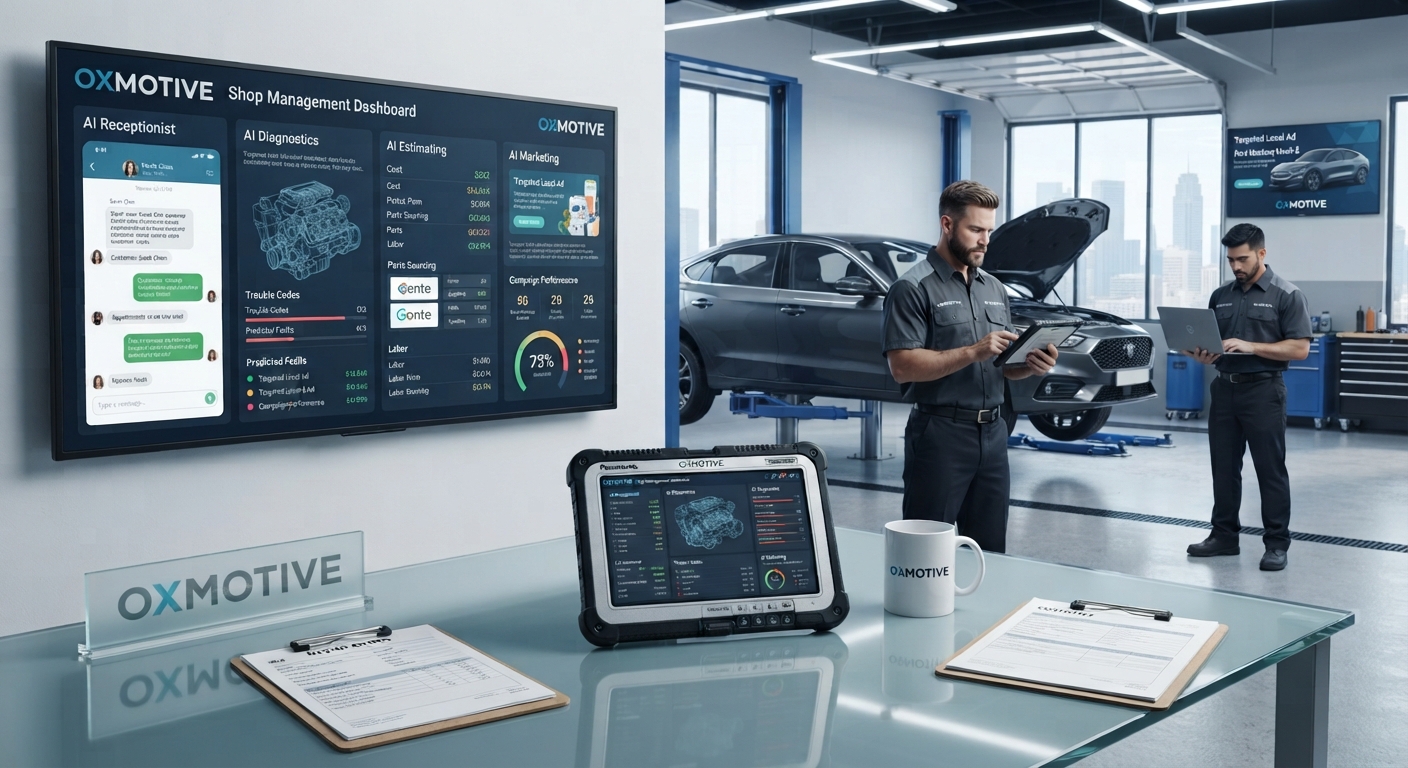
The conversation about AI in automotive has shifted from vague promise to specific roles. Rather than one all-purpose AI, the industry is coalescing around AI agents that each take on a defined job a shop already needs done. Four roles stand out in 2026: the receptionist, the diagnostician, the estimator, and the marketer. Understanding these four is the clearest way to grasp where AI is actually landing in shops, and, importantly, what they all require to work. This guide breaks down each role and the foundation that makes any of them useful.
From general AI to AI with a job
Early AI hype imagined a single system that could do everything. What is actually being deployed is more specific and more useful: agents built around distinct roles that map to real shop functions. Industry commentary in 2026 draws a useful distinction between AI that helps you do things and AI that actually does things, and the agents taking hold in automotive increasingly do defined work end to end. Framing AI as a set of role-players rather than a magic box makes it far easier to understand what it can do for a shop and to evaluate whether any given tool is worth adopting. The four roles below are where this is happening most visibly.
Role one: the AI receptionist
The most widely adopted AI role in automotive is the receptionist. These AI voice agents answer calls around the clock, book and reschedule appointments, capture vehicle information, answer common questions, and make sure no inquiry goes unanswered even after hours or during a rush. The problem they solve is concrete and expensive: missed calls are missed revenue, and a great deal of shop business still comes through the phone. An AI receptionist ensures every call is captured and turned into a booking or a lead rather than a lost opportunity, which is why this role has moved fastest from concept to real deployment across the industry.
Role two: the AI diagnostician
In repair-oriented shops, AI has taken on the role of diagnostic assistant. Modern vehicles generate vast amounts of sensor and control-unit data, and AI diagnostic tools analyze it to pinpoint likely root causes quickly, helping technicians reach the right fix faster and improving first-time fix rates. Reporting on these tools describes meaningful speed gains and error reductions, with the technician still firmly in charge. The AI does the heavy data analysis; the skilled human does the judgment and the work. For appearance and protection shops this role is less directly relevant, but it illustrates the broader pattern of AI taking over the data-intensive part of a job while people handle the craft.
Role three: the AI estimator
Estimating is the third role AI is stepping into. AI estimating tools draw on a shop's historical data and large volumes of past work orders to generate quotes that are faster, more consistent, and more transparent than manual, memory-based estimates. Because quoting is a frequent bottleneck and a common source of both lost jobs and disputes, an estimator that produces accurate quotes quickly addresses a real weakness. The catch, and it is a crucial one, is that an AI estimator is only as good as the historical job and pricing data it can draw on. A shop with organized records can feed it; a shop running on scattered notes has nothing for it to learn from.
Role four: the AI marketer
The fourth role is marketing and retention. AI marketing agents identify which customers are due for service, which have gone quiet, and which represent an opportunity, then help reach them with relevant, timely, personalized messages instead of generic blasts. Some can predict when a vehicle may need attention based on its history and proactively prompt outreach. This role turns the customer data a shop already has into recovered and repeat business, automating the follow-up that most shops know they should do but rarely execute consistently. Like the estimator, the AI marketer depends entirely on having clean, organized customer data to work from.
What every AI role has in common: your data
Step back from the four roles and the pattern is unmistakable: every one of them runs on your shop's data. The receptionist needs your customer and appointment information, the diagnostician needs vehicle data, the estimator needs historical job and pricing data, and the marketer needs organized customer records. AI agents are not magic, they are engines that run on the fuel of good data, and a shop whose information is scattered across paper, phones, and memory has no fuel to give them. This is the decisive insight for any owner thinking about AI: the groundwork is not choosing an AI product, it is getting your data organized so that any of these roles can actually work for you. Keeping customer and vehicle records, job and pricing history, and business data organized in one system is what positions a shop to benefit from AI agents rather than watch them from the sidelines. For the wider view of these shifts, see our piece on how AI is changing the automotive industry.
How it comes together
AI is arriving in automotive not as one system but as four defined roles: the receptionist that captures every call, the diagnostician that speeds up repairs, the estimator that produces data-driven quotes, and the marketer that drives retention. Each solves a real shop problem, and each depends completely on organized data to function. For any shop, the winning move is not to rush at the flashiest AI tool but to build the organized data foundation that makes every one of these roles possible. Get that right, and you are ready to put AI agents to work whenever they fit your business, rather than being locked out for lack of usable data.
Frequently asked questions
What are the main AI agent roles in automotive shops?
Four roles stand out in 2026: the AI receptionist, which answers calls and books appointments around the clock; the AI diagnostician, which analyzes vehicle data to speed up repairs; the AI estimator, which generates data-driven quotes from historical work orders; and the AI marketer, which identifies and reaches customers for retention. Each maps to a real shop function and does defined work rather than acting as a single all-purpose system.
What does an AI receptionist do for an auto shop?
An AI receptionist answers calls around the clock, books and reschedules appointments, captures vehicle information, answers common questions, and ensures no inquiry goes unanswered even after hours or during a rush. It solves a concrete, expensive problem, since missed calls are missed revenue and much shop business still comes through the phone. This is the most widely adopted AI role in automotive because the payoff is so direct.
How does an AI estimator work?
An AI estimator draws on a shop's historical data and large volumes of past work orders to generate quotes that are faster, more consistent, and more transparent than manual estimates. Since quoting is a common bottleneck and source of lost jobs and disputes, this addresses a real weakness. The crucial catch is that it is only as good as the historical job and pricing data it can draw on, so organized records are a prerequisite.
Will AI agents replace shop staff?
The pattern in 2026 is AI taking over the data-intensive part of a job while people handle judgment and craft, for example AI diagnostics speed analysis while the technician stays in charge of the repair. AI agents handle defined, repetitive, or data-heavy work like answering calls, analyzing data, drafting quotes, and targeting outreach, which frees staff for higher-value work rather than wholesale replacing them.
What do I need before adopting AI in my shop?
Organized data. Every AI role runs on it: the receptionist needs customer and appointment information, the diagnostician needs vehicle data, the estimator needs historical job and pricing data, and the marketer needs clean customer records. A shop with scattered information across paper, phones, and memory has no fuel to give these tools. Getting your data organized in one system is the real groundwork for benefiting from any AI agent.
[[END FAQ]]
This article offers a general overview based on industry reporting. AI capabilities and results vary by tool, so evaluate any AI product against your own shop's needs.
Subscribe to our newsletter today
Fresh insights and practical tips delivered every week.