.svg)
How AI Is Changing the Automotive Industry in 2026
AI has moved from buzzword to working tool in automotive. Here is how AI is changing the industry in 2026, across diagnostics, customer service, estimating, and marketing, and what it means for your shop.

.png)
Helping auto shops work smarter and grow.
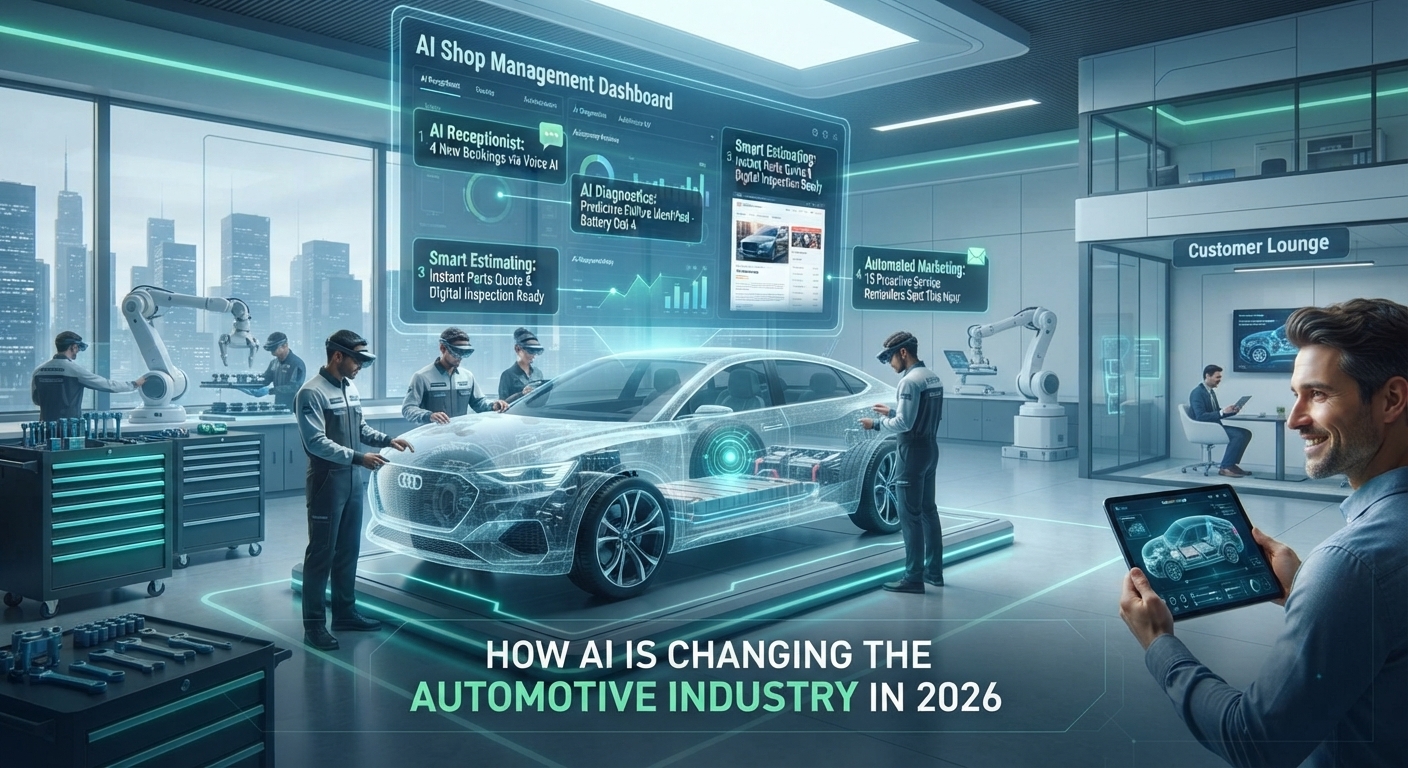
Artificial intelligence has moved from a buzzword to a working part of the automotive world, and 2026 is the year the shift became impossible to ignore for anyone running a shop. AI is now embedded in how vehicles are diagnosed, how customers are handled, how estimates are produced, and how shops market themselves. For appearance and protection businesses, understanding these changes is not about chasing hype, it is about seeing where the industry is heading so you can adapt on your own terms. This guide covers how AI is genuinely changing the automotive industry and what it means for a shop like yours.
AI in vehicle diagnostics and repair
One of the most established uses of AI in automotive is diagnostics. Modern vehicles carry hundreds of sensors and electronic control units producing enormous amounts of data, and AI tools now analyze that data to identify root causes far faster than traditional trial-and-error methods. Industry coverage reports that AI-assisted diagnostic tools can significantly speed up diagnosis and improve first-time fix rates, with some reporting notable reductions in diagnostic errors. The consensus in industry reporting is that AI is augmenting technicians rather than replacing them, handling the data-heavy analysis so skilled people can focus on the actual repair. For repair-oriented shops, this is already changing how the work gets done.
AI in customer service and the front desk
The second major shift is in customer handling. AI voice agents and virtual receptionists have become a real category in automotive, able to answer calls around the clock, book and reschedule appointments, capture vehicle details, and handle common questions without a human picking up. The appeal is obvious: a great deal of shop business still runs through the phone, and missed calls are missed revenue, so an always-available system that captures every inquiry addresses a genuine pain point. Whether or not a given shop adopts a full AI receptionist, the underlying lesson, that customers increasingly expect instant response and round-the-clock availability, applies to every business in the industry.
AI in estimating and quoting
AI is also reshaping how estimates are produced. New tools generate data-driven estimates by drawing on a shop's historical data and large volumes of past work orders, aiming to make quotes faster, more consistent, and more transparent. Because accurate, quick quoting is a common bottleneck and a frequent source of lost jobs and disputes, this is a meaningful development. The direction is clear: estimating is moving from a manual, memory-based task toward a data-informed one, which rewards shops that actually have their historical job and pricing data organized and available, and disadvantages those whose information lives in scattered notes that no tool can draw on.
AI in marketing and customer retention
On the growth side, AI is changing how shops find and keep customers. AI-driven systems can identify customers who are due for service, have gone quiet, or represent an opportunity, and can help target the right message to the right person, turning marketing from broad guesswork into something more precise. Predictive approaches can even flag when a vehicle may be due for attention based on its history. The through-line is personalization at scale: using data to reach customers with relevant, timely communication rather than generic blasts. As with estimating, this rewards shops that have organized customer data for the AI to work with, since these tools are only as good as the information underneath them.
The common thread: AI runs on organized data
Across diagnostics, customer service, estimating, and marketing, one pattern holds: every one of these AI capabilities depends on good, organized data. AI diagnostics need vehicle data, AI estimating needs historical job and pricing data, AI marketing needs clean customer records. A shop whose information is scattered across paper, texts, and memory cannot feed these tools and cannot benefit from them, no matter how advanced they become. This is the most important strategic takeaway for any shop watching the AI wave: the businesses positioned to benefit are the ones that have already organized their operations and data. Getting your house in order is the prerequisite for participating in what comes next.
What this means for appearance and protection shops
Much AI coverage focuses on dealerships and mechanical repair, but the implications reach every shop, including detailing, wrap, tint, and protection businesses. You may not need an AI diagnostic tablet, but you will feel the rising customer expectation for instant response, the shift toward data-driven quoting, and the advantage that data-rich competitors gain in marketing. The practical move is not to chase every AI product, but to build the organized foundation that lets you adopt whatever genuinely helps, on your timeline. Keeping your customer and vehicle data, job history, and business records organized in one system is exactly that foundation. For how AI agents specifically are taking on defined shop roles, see our companion piece on the four AI roles reshaping automotive.
How it comes together
AI is genuinely changing the automotive industry in 2026, speeding up diagnostics, handling customer calls and bookings, producing data-driven estimates, and sharpening marketing and retention. Underneath every one of these advances is the same requirement: organized data. For appearance and protection shops, the smart response is not to chase hype but to recognize the direction of travel and build the organized operational foundation that lets you adopt what helps when it makes sense. The shops that have their data in order will be the ones positioned to benefit from AI; the ones running on memory and paper will be left watching.
Frequently asked questions
How is AI being used in the automotive industry?
AI is now used across four main areas of automotive service: diagnostics, where it analyzes vehicle sensor data to speed up root-cause identification; customer service, where AI voice agents answer calls and book appointments around the clock; estimating, where tools generate data-driven quotes from historical work orders; and marketing, where AI targets the right customers with timely, relevant outreach. Each has moved from concept to real, deployed use in 2026.
Is AI replacing auto technicians?
According to industry reporting, AI is augmenting technicians rather than replacing them, handling the data-heavy analysis so skilled people can focus on the actual repair. AI diagnostic tools speed up diagnosis and improve first-time fix rates, but the human technician remains central. Some routine tasks may change as automation grows, and new roles are expected to appear, such as technicians who maintain the AI systems themselves.
What is an AI receptionist for an auto shop?
It is an AI voice or virtual agent that answers calls around the clock, books and reschedules appointments, captures vehicle details, and handles common questions without a human picking up. Because much shop business still runs through the phone and missed calls are missed revenue, an always-available system that captures every inquiry addresses a real pain point. Even shops that do not adopt one should note the rising customer expectation for instant, round-the-clock response.
Do appearance and protection shops need to worry about AI?
Even though much AI coverage focuses on dealerships and mechanical repair, the implications reach detailing, wrap, tint, and protection shops through rising expectations for instant response, the shift to data-driven quoting, and the marketing advantage data-rich competitors gain. The practical move is not to chase every AI product but to build an organized data foundation so you can adopt whatever genuinely helps on your own timeline.
Why does AI depend on organized data?
Because every AI capability is only as good as the information underneath it. AI diagnostics need vehicle data, AI estimating needs historical job and pricing data, and AI marketing needs clean customer records. A shop whose information is scattered across paper, texts, and memory cannot feed these tools or benefit from them. That is why getting your data organized is the prerequisite for participating in what AI makes possible.
[[END FAQ]]
This article offers a general overview of AI trends in automotive based on industry reporting. Specific tools, capabilities, and results vary, so evaluate any AI product against your own shop's needs.
Subscribe to our newsletter today
Fresh insights and practical tips delivered every week.