.svg)
Business Analytics on Services: What Owners, Managers, and Investors Should Track
Instinct can't be shared with a manager or shown to an investor, but numbers can. Here are the service analytics owners, managers, and investors should track to run and grow a shop.

.png)
Helping auto shops work smarter and grow.
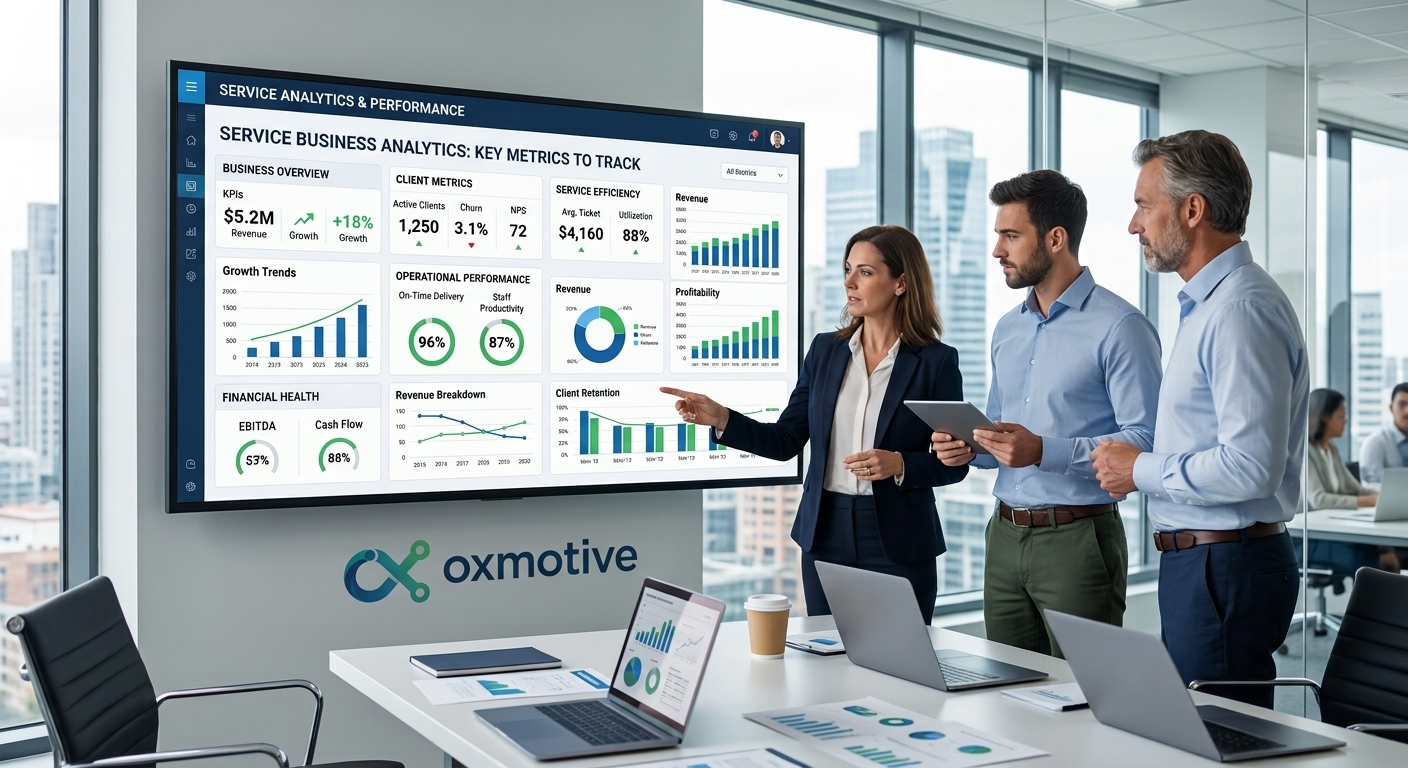
Most appearance and protection shops run on instinct, the owner has a gut feel for which services do well and which customers matter. Instinct is valuable, but it cannot be shared, audited, or scaled, and it is not what a manager needs to run a location or an investor needs to evaluate the business. Real business analytics, clear numbers on how your services perform, turns that instinct into evidence anyone can act on. This guide covers the service analytics that matter to three audiences, owners, managers, and investors, and why tracking them changes how a shop is run and valued.
Why analytics matter beyond gut feel
Gut feel gets a shop started, but it hits limits as the business grows. It cannot tell you precisely which service line earns the most profit, whether retention is improving or slipping, or which location is truly outperforming, and it certainly cannot be handed to a manager or shown to an investor. Analytics replace opinion with evidence, letting you see what is actually happening rather than what you assume. That shift matters because decisions based on real numbers, about pricing, staffing, marketing, and expansion, are simply better than decisions based on impressions, and because a business that can show its numbers is far easier to manage and to value than one that runs entirely in the owner's head.
Service performance: which work actually pays
The most important analytics for an appearance shop are about the services themselves. Which services generate the most revenue, and just as importantly, which generate the most profit after the time and materials they consume? A high-revenue service can be less profitable than a quieter one once you account for hours and cost, and you cannot see that without tracking it. Knowing your service mix, how demand splits across detailing, coating, wraps, tint, and protection, and the true profitability of each, tells you what to promote, what to reprice, and where to focus. This is the analytical foundation everything else builds on, because it answers the core question of what work actually pays.
What owners should track
An owner needs the widest view: overall revenue and its trend over time, service-mix and per-service profitability, customer retention and repeat rates, where new customers come from, and how efficiently the shop converts leads and fills capacity. These numbers let an owner steer the whole business, doubling down on profitable services, fixing weak retention, reallocating marketing to what works. The owner's job is direction, and direction requires seeing the whole picture in numbers rather than fragments in memory. A shop where the owner watches these metrics is being actively steered; one where nobody watches them is drifting, however busy it feels day to day.
What managers should track
A manager runs the operation day to day, so their analytics are more operational: bay and staff utilization, job throughput and turnaround, schedule fill and no-show rates, and how their location or team is performing against targets. These are the levers a manager actually controls, and giving them the numbers turns management from firefighting into deliberate improvement. Importantly, clear operational analytics also let an owner delegate, because a manager can be held to visible metrics rather than vague impressions. Shared, objective numbers are what make it possible to hand a location to a manager and trust that it is running well, which is essential for any shop that wants to grow beyond the owner's direct reach.
What investors and partners look for
If you ever seek investment, a partner, or a buyer, analytics stop being optional and become the language of the conversation. Investors evaluate a business on its numbers: revenue trends and growth, profit margins, customer retention and lifetime value, customer acquisition cost, and the consistency and predictability of it all. A shop that can produce these clearly signals a real, well-run business and commands a far better valuation than one whose owner can only describe it anecdotally. Even if you never take investment, running your shop as though an investor might look, with clean, credible numbers, forces the discipline that makes the business stronger and keeps the option open. The ability to show your numbers is itself a form of business value.
Turning data into a habit, not a project
Analytics only help if they are current and easy to see, which means they cannot be an annual spreadsheet scramble. The practical answer is a system that captures every customer, job, and dollar as part of normal work and turns that into live reporting you can check anytime, rather than data you reconstruct after the fact. When the numbers are always there, reviewing them becomes a habit that steadily improves the business instead of a painful project everyone avoids. Keeping real-time reporting on top of your customer records and job data, with data export for deeper analysis or sharing with an accountant or investor, is what makes analytics a routine part of running the shop. For why the underlying data matters, see our piece on customer data as a competitive advantage.
How it comes together
Business analytics turn a shop from something run on instinct into something run on evidence, and different audiences need different views: owners need the whole-business picture to set direction, managers need operational metrics to run locations well and be accountable, and investors need clean financial and retention numbers to value the business. At the center of all three is service performance, knowing which work truly pays. Build the habit of capturing and reviewing these numbers, and you run a shop that steers deliberately, delegates confidently, and stands up to any outside scrutiny, which is a fundamentally stronger and more valuable business.
Frequently asked questions
What business analytics should a shop owner track?
An owner needs the widest view: overall revenue and its trend, service-mix and per-service profitability, customer retention and repeat rates, where new customers come from, and how efficiently the shop converts leads and fills capacity. These let an owner steer the whole business, promoting profitable services, fixing weak retention, and reallocating marketing to what works, rather than running on impressions that cannot be audited or scaled.
Which service metrics matter most for an appearance shop?
The most important are which services generate the most revenue and, crucially, the most profit after the time and materials they consume. A high-revenue service can be less profitable than a quieter one once hours and cost are counted. Knowing your service mix and the true profitability of each, across detailing, coating, wraps, tint, and protection, tells you what to promote, what to reprice, and where to focus.
What analytics do managers need versus owners?
Managers need operational metrics they control: bay and staff utilization, job throughput and turnaround, schedule fill and no-show rates, and performance against targets. Owners need the broader strategic view of revenue, profitability, and retention across the business. Operational analytics also let owners delegate, since a manager can be held to visible metrics rather than vague impressions, which is essential for growing beyond the owner's direct reach.
What numbers do investors look for in a shop?
Investors evaluate a business on revenue trends and growth, profit margins, customer retention and lifetime value, customer acquisition cost, and the consistency and predictability of those figures. A shop that can produce them clearly signals a real, well-run business and commands a better valuation than one described only anecdotally. Running your shop as if an investor might look forces discipline that makes it stronger even if you never take investment.
How do I make analytics a regular habit?
Use a system that captures every customer, job, and dollar as part of normal work and turns it into live reporting you can check anytime, rather than an annual spreadsheet scramble. When the numbers are always current and easy to see, reviewing them becomes a routine that steadily improves the business instead of a painful project everyone avoids. Real-time reporting on top of your customer and job data is what makes this practical.
[[END FAQ]]
This article offers general business guidance and is not financial or investment advice. Consult a qualified professional for financial analysis and valuation.
Subscribe to our newsletter today
Fresh insights and practical tips delivered every week.