.svg)
How Mobile Detailing Shops Win by Building CRM and Mobile Into Their Workflow
Mobile detailing runs out of a vehicle, which makes managing information make-or-break. Here is how mobile detailers win by building a CRM and mobile app into their daily workflow.

.png)
Helping auto shops work smarter and grow.
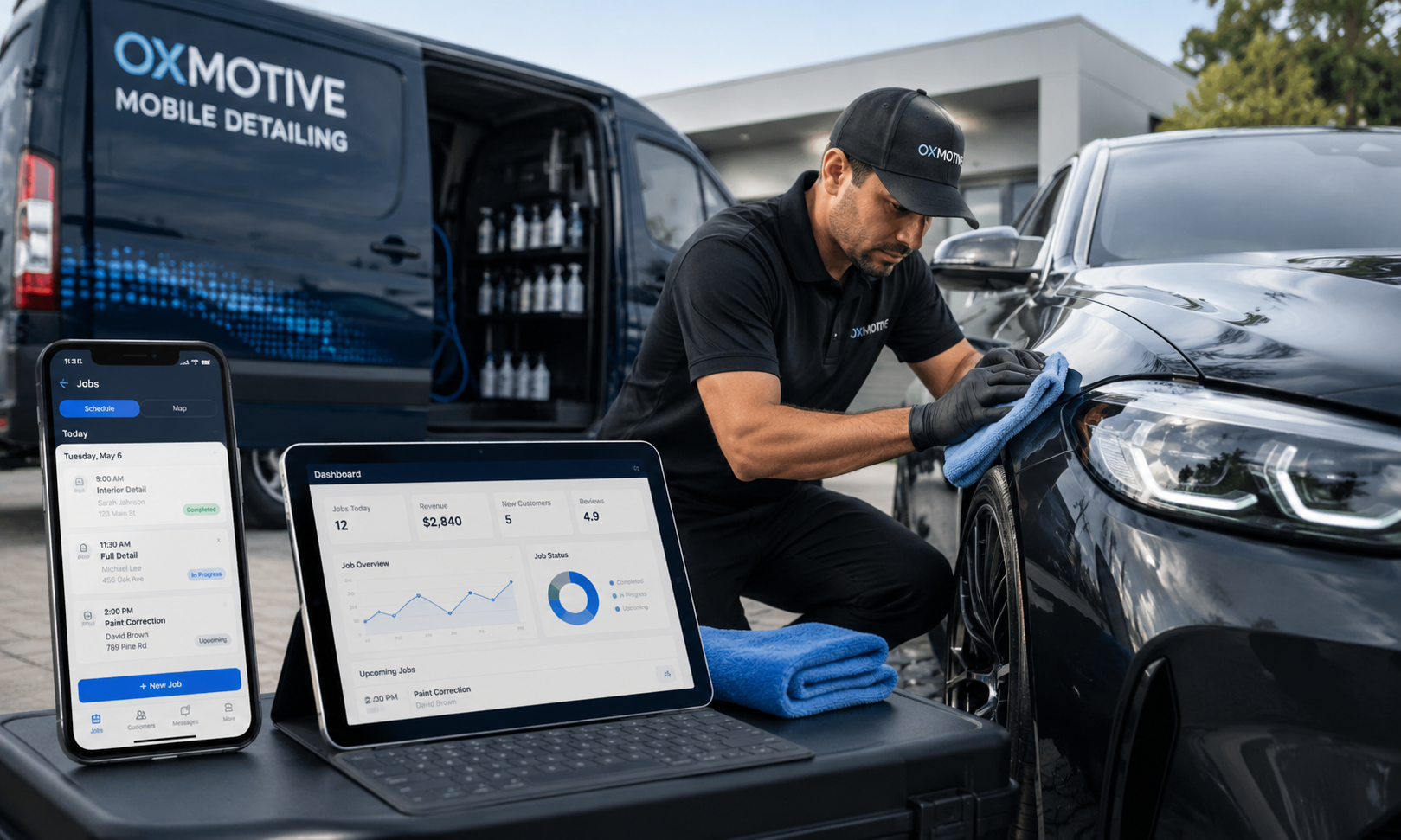
Mobile detailing has a built-in advantage, you bring the service to the customer, but it also has a built-in challenge: your whole business runs out of a vehicle, with no front desk, no back office, and no computer to return to. That reality makes how a mobile detailer manages information the difference between a scattered hustle and a smooth, growing business. The operators who are winning are the ones who have built a CRM and mobile app directly into their daily workflow. This guide explains how that combination transforms a mobile detailing operation and why it fits the mobile model so well.
The mobile detailer's core challenge
A fixed shop has a location where information can live, a desk, a computer, a filing system. A mobile detailer has none of that; the business is you, your vehicle, and your phone, moving from job to job across the day. This is precisely why so many mobile detailers run on memory, texts, and scraps of paper, and precisely why that approach breaks down as they grow. Without a place for information to live and travel with you, customer details get lost, follow-ups are forgotten, and every day starts with reconstructing what needs to happen. Solving this information problem is the key to scaling a mobile operation, and it is exactly what a mobile-first CRM does.
Your business in your pocket
The breakthrough for a mobile detailer is having the entire business accessible from a phone. A mobile CRM puts your full customer list, every vehicle and service history, your schedule, and your job details in your pocket, available at every stop. You can pull up a customer before you arrive, see exactly what you did last time, and know what to recommend, all from the driveway. Because your operation has no fixed base, having everything travel with you is not a convenience, it is the foundation that makes the business work. This is the single biggest reason a mobile app matters more to a mobile detailer than to almost any other kind of shop.
Capturing every job on the spot
Building the app into your workflow means the record is complete the moment you finish, not hours later. At each job you add or update the customer, capture before-and-after photos straight to the record, note what you did, and mark it complete, all before you drive to the next stop. This eliminates the end-of-day pile of admin that mobile detailers dread and the forgotten details that come with trying to remember five jobs at once. Capturing everything on the spot keeps your records accurate and your evenings free, and it means the marketing photos and service history you need later are always there, because you captured them when you were standing at the car.
Never losing a lead between stops
Mobile detailers live on their phones for leads, which is both an opportunity and a trap, because inquiries arrive while you are mid-job and easily vanish. Building lead capture into your workflow means every inquiry lands in one place you check between stops rather than scattered across texts and social apps you miss while working. Being able to respond quickly, even with a brief acknowledgment, from wherever you are is how you win jobs that a slower competitor loses. For a mobile operator with no one answering a front desk, a system that catches and organizes leads so you can respond between appointments directly protects the revenue that would otherwise slip away while your hands are busy.
Turning one-time jobs into recurring routes
The economics of mobile detailing improve dramatically with repeat customers, because a dense route of regulars is far more efficient and profitable than constantly chasing new one-off jobs across town. This is where CRM-driven follow-up changes the business: because the system remembers every customer and when they are due, it lets you bring them back on a regular cadence and build recurring bookings and memberships that fill your schedule predictably. Systematic follow-up and recurring plans turn scattered one-time jobs into a stable, efficient route of repeat customers, which is the difference between a mobile detailer who is always hunting and one who has a dependable book of business. The CRM is what makes that retention systematic instead of accidental.
How it fits together in the daily workflow
The winning mobile detailers do not treat the CRM as separate admin, they build it into the rhythm of the day: check leads and schedule in the morning, pull up each customer on arrival, capture the job and photos before leaving, and let automated follow-up handle bringing customers back. Done this way, the system is not extra work, it is how the work flows, and it quietly runs the retention and organization that grow the business. Keeping customer records, job tracking, photo capture, and follow-up together in a mobile app built for the road is what makes this possible. For keeping the calendar full in the slow season, see our guide on staying booked through winter, and for the broader why, our piece on the CRM and mobile app combination.
How it comes together
Mobile detailing runs out of a vehicle, which makes managing information the make-or-break skill, and the operators who win are the ones who build a CRM and mobile app into the daily workflow rather than running on memory and texts. Your whole business in your pocket, every job captured on the spot, no lead lost between stops, and one-time jobs turned into recurring routes, together these turn a scattered hustle into a smooth, scalable operation. Build the system into how your day already flows, and it does the organizing and retention that let a mobile detailing business genuinely grow.
Frequently asked questions
Why do mobile detailers need a CRM and mobile app specifically?
Because a mobile detailer has no fixed location, front desk, or office computer, the business is you, your vehicle, and your phone, moving between jobs. Without a place for information to live and travel with you, details get lost and follow-ups forgotten. A mobile CRM solves this by putting your whole business, customers, schedule, and job details, in your pocket, available at every stop, which is the foundation that makes the operation work.
How does a mobile app improve a detailer's daily workflow?
It lets you complete the record where the work happens. At each stop you pull up the customer before arriving, capture before-and-after photos straight to the job, note what you did, and mark it complete before driving on. This eliminates the dreaded end-of-day admin pile and the forgotten details of trying to remember several jobs at once, keeping records accurate and evenings free while ensuring photos and history are always captured.
How does a CRM help a mobile detailer win more leads?
By catching every inquiry in one place you check between stops, rather than scattered across texts and social apps you miss while working. Being able to respond quickly, even with a brief acknowledgment, from wherever you are is how you win jobs a slower competitor loses. For a mobile operator with no one at a front desk, this directly protects revenue that would otherwise slip away while your hands are busy.
How do mobile detailers build recurring business?
Through CRM-driven follow-up. Because the system remembers every customer and when they are due, it lets you bring them back on a regular cadence and build recurring bookings and memberships. That turns scattered one-time jobs into a dense, efficient route of regulars, which is far more profitable than constantly chasing new one-off work across town, and it makes retention systematic instead of accidental.
Is a CRM extra work for a busy mobile detailer?
Not when it is built into the daily rhythm. The winning approach is to check leads and schedule in the morning, pull up each customer on arrival, capture the job and photos before leaving, and let automated follow-up bring customers back. Done this way the system is not separate admin, it is how the work flows, quietly running the organization and retention that grow the business.
[[END FAQ]]
This article offers general business guidance for mobile detailers. Send customer outreach in compliance with applicable consent and anti-spam rules.
Subscribe to our newsletter today
Fresh insights and practical tips delivered every week.