.svg)
From Solo Wrap Shop to Second Location: A Brampton Owner’s Growth Roadmap
A practical Brampton roadmap for vehicle wrap shop owners deciding when to open a second location and what must be systematized first.

.png)
Helping auto shops work smarter and grow.

A second wrap-shop location can increase capacity, shorten customer travel, and open the door to larger commercial accounts. It can also double your fixed costs before it adds dependable revenue. The difference is whether your first location runs on repeatable systems or still depends on you remembering every quote, deposit, design change, and install date.
This roadmap helps a Brampton wrap and tint owner decide whether location number two is justified, calculate what it must produce, and build the operating system before signing a lease.
Why Brampton can support a growing vehicle wrap business
Brampton gives wrap shops access to more than personal colour-change work. The city sits inside a dense transportation, distribution, manufacturing, trades, and small-business market where commercial vehicles are visible assets. Vans, pickups, delivery vehicles, contractor fleets, service vehicles, and owner-operated trucks all need branding that can be installed, repaired, removed, and updated.
The City of Brampton Economic Development Office describes Brampton as a major logistics hub and home to Canada’s largest intermodal terminal. Major highways, rail infrastructure, and proximity to Pearson International Airport support a large flow of businesses and commercial vehicles. The city also identifies advanced manufacturing as its largest employment sector, with automotive and industrial companies forming part of the local economy.
That does not guarantee demand for a second studio. It does mean the local market supports several customer types, including retail owners, tradespeople, small fleets, logistics operators, dealerships, and businesses that need repeat graphics.
The second location still needs to solve a specific constraint. It should not be opened simply because the first shop feels busy.
1. Prove the first location is full, not simply disorganized
A packed calendar is not proof that you need another building. One bay can feel overloaded because quoting is slow, deposits are missing, designs are approved late, customers arrive unprepared, or installers are waiting for material. A second location will reproduce those delays at a higher cost.
Run a four-week capacity review. Track:
- Available installation bay-days
- Bay-days used for paid installation work
- Jobs delayed specifically by space limitations
- Jobs delayed by approvals, deposits, materials, or scheduling errors
- Qualified work declined because the shop could not offer a reasonable date
- Customers or fleet prospects lost because the location was inconvenient
- Owner hours spent solving routine operating problems
You are closer to needing location two when paid work consistently uses production capacity and profitable jobs are being turned away because of space or geography. You are not ready when the schedule appears full but bays sit empty while the team waits for information.
Use this readiness checklist:
- The first shop has stable positive cash flow across normal seasonal changes.
- You know which job types produce healthy contribution.
- Pricing does not change depending on who answers the phone.
- Deposits and approvals are collected before material and bay time are committed.
- A team member other than the owner can run a normal day.
- Customer, vehicle, quote, media, and job records live in one system.
- You can explain which demand will move to or be created by the second location.
If several statements are false, fix location one before duplicating it.
2. Calculate the second location’s break-even job count
The lease is only one part of the monthly commitment. Location two may add a manager or lead installer, utilities, insurance, security, equipment financing, waste handling, software, local marketing, and working capital for film and supplies.
Use this calculation:
Monthly break-even jobs = added monthly fixed costs ÷ average contribution per completed job
Average contribution per job is job revenue minus direct material, outsourced production, variable installer labour, and other direct job costs. It is not total revenue.
Build the calculation from your own numbers:
- Added fixed costs: Rent, base wages, utilities, insurance, equipment, software, and marketing
- Average job revenue: Based on the work you realistically expect at location two
- Average direct cost: Film, laminate, printing, variable labour, and outsourced work
- Average contribution: Job revenue minus direct cost
Stress-test the result. What happens if opening is delayed, the first three months produce fewer jobs than planned, or the new studio attracts smaller work? Add a cash reserve and decide the maximum loss you can carry without starving the original shop.
Separate transferred revenue from new revenue. Moving existing customers to a new location may improve service and capacity, but it does not create new company-wide sales by itself.
3. Standardize the quote-to-install workflow before copying it
The second location will expose every unwritten rule in the first one. If one person knows how to price difficult vehicles, another remembers deposit exceptions, and the owner approves every rush job, the business is not expandable.
Document one quote-to-install workflow:
- Inquiry: Capture the customer, vehicle, coverage, design status, timing, preferred location, and reference images.
- Inspection: Record vehicle condition, existing film, paint concerns, removal, disassembly, and installation complexity.
- Quote: Apply the same labour assumptions, material rules, revision allowance, exclusions, and change-order process.
- Commitment: Collect the required deposit and acceptance before ordering custom material or reserving multi-day bay time.
- Design: Track versions, customer feedback, final approval, and production-ready artwork.
- Production: Confirm film, print, laminate, colour, quantity, and arrival date.
- Installation: Assign the bay, installer, duration, preparation instructions, and quality checks.
- Completion: Record final photos, material details, care instructions, balance, warranty information, and follow-up.
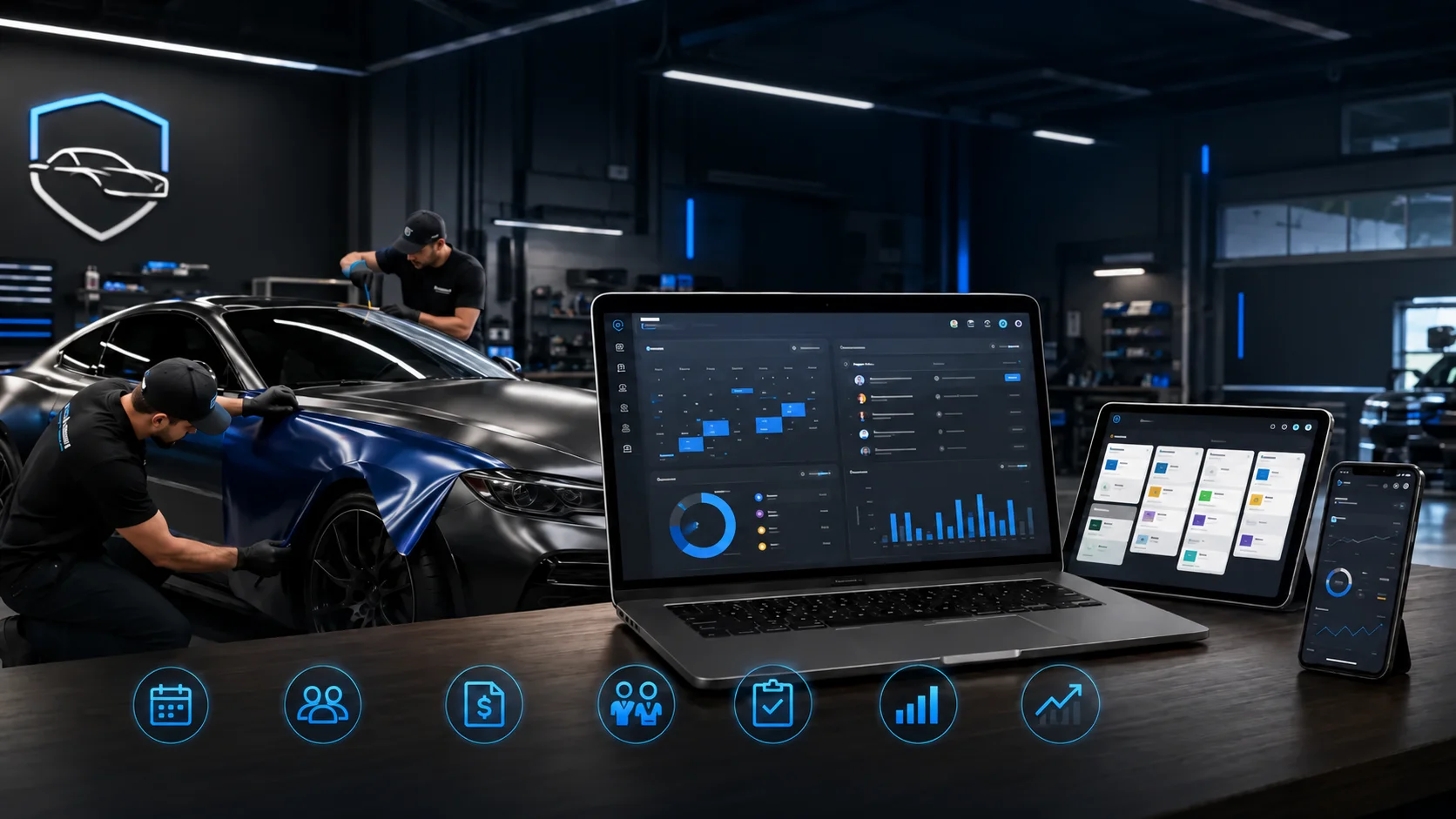
OXMotive can keep structured quotes, deposit status, schedules, customer records, service history, and job communication connected. Define the workflow first, then configure the system so both locations follow the same handoffs.
Read more about where wrap shops lose money between the quote and the install.
4. Make scheduling, communication, and quality control owner-independent
Two locations create more places for a promise to be missed. A customer can book at the wrong studio, a designer can send a revision to the wrong employee, or a vehicle can arrive while its film is stored elsewhere.
Every booking should show:
- The location and person that own the job
- The next required action
- Deposit and design-approval status
- Material availability and location
- Reserved bay-days and assigned installer
- The next promised customer update
Use one shared schedule and one customer record rather than separate spreadsheets. Automated reminders reduce manual chasing, while two-way texting gives customers a clear communication channel. Keep each conversation attached to the correct customer, vehicle, job, and location.
Now remove the owner as the only quality-control system. Assign responsibility and approval limits for quotes, deposit exceptions, design confirmation, material ordering, schedule changes, vehicle-condition documentation, final inspection, complaints, and warranty decisions.
Create checklists for work that must be consistent, then define when employees can use judgment. A location lead should resolve normal issues without calling the owner. Higher-risk pricing, paint-condition, warranty, and customer disputes should have a clear escalation path.
Train with real completed jobs, including a profitable full wrap, a removal-heavy project, a repeat fleet order, a difficult design cycle, and a job the shop should have declined.
OXMotive’s roles, permissions, mobile job updates, photos, videos, centralized history, and multi-location shop management give the owner visibility without requiring physical presence at every handoff.
5. Launch location two as a controlled operating test
Do not judge the new studio only by revenue. A busy location can still damage the company if it underquotes, absorbs excessive revisions, misses deposits, produces rework, or constantly borrows staff from the first shop.
For the first 90 days, compare both locations using the same definitions:
- Qualified inquiries and quotes sent
- Quote approval rate
- Deposits collected before scheduling or material ordering
- Average contribution per completed job
- Bay use and jobs completed on time
- Material waste, reprints, and rework
- Customer feedback and review themes
- Repeat, referral, and fleet opportunities
- Owner interventions required
Review exceptions weekly. If one location discounts more often, misses more documentation, or takes longer to move from approval to install, investigate the workflow behind the number.
Cross-location reporting should show one company with two operating units, not two separate businesses that happen to share a logo. OXMotive can give owners a shared view of customers, jobs, team activity, follow-up, and location performance.
How it fits together: expand the system, not the owner’s workload
A Brampton wrap shop is ready for location two when the first studio has proven demand, reliable contribution, documented handoffs, portable customer records, and a team that can operate without constant owner intervention.
The order matters. Prove the constraint. Calculate break-even. Standardize quoting, deposits, approvals, scheduling, and follow-up. Train people around the same process. Then open the second location as a measured test and compare both studios through one reporting system.
The CRM makes the model portable by giving each location the same customer history, job status, communication context, documentation, and operating visibility. See how OXMotive supports wrap and tint studios that need a simpler way to organize customers and jobs.
Frequently asked questions
How do I know when my Brampton wrap shop is ready for a second location?
You are closer when profitable work consistently fills real production capacity, jobs are declined because of space or geography, cash flow is stable, and the shop can operate without the owner controlling every step. A full calendar caused by missing approvals, materials, or poor scheduling is not full capacity.
How much money should a wrap shop save before opening location two?
There is no universal amount. Calculate setup costs, added monthly fixed costs, working capital, and a reserve for a slower-than-planned opening. The reserve should protect both the new location and the original shop.
What should be standardized before opening a second wrap studio?
Standardize intake, inspection, pricing, quote approval, deposits, design revisions, material ordering, scheduling, installation checks, completion records, and follow-up. Each step needs a clear owner and required information.
Should the second location use a separate customer database?
No. Separate databases create duplicate customers, fragmented vehicle histories, inconsistent follow-up, and weak company-wide reporting. Both studios should use one controlled system with location-based permissions.
How can OXMotive help a wrap shop expand?
OXMotive connects quoting, deposits, scheduling, reminders, texting, customer and vehicle records, follow-up, reporting, and multi-location operations. That shared record helps a growing shop repeat the same workflow without depending on the owner’s memory.
Considering a second wrap-shop location in Brampton? Book a demo of OXMotive to see how one system can support both studios.
Subscribe to our newsletter today
Fresh insights and practical tips delivered every week.