.svg)
Why Vehicle Wrap Shops Lose Money Between the Quote and the Install (And How to Fix It)
Discover five profit leaks between a vehicle wrap quote and installation—and the systems wrap shops can use to protect margins and keep jobs organized.

.png)
Helping auto shops work smarter and grow.
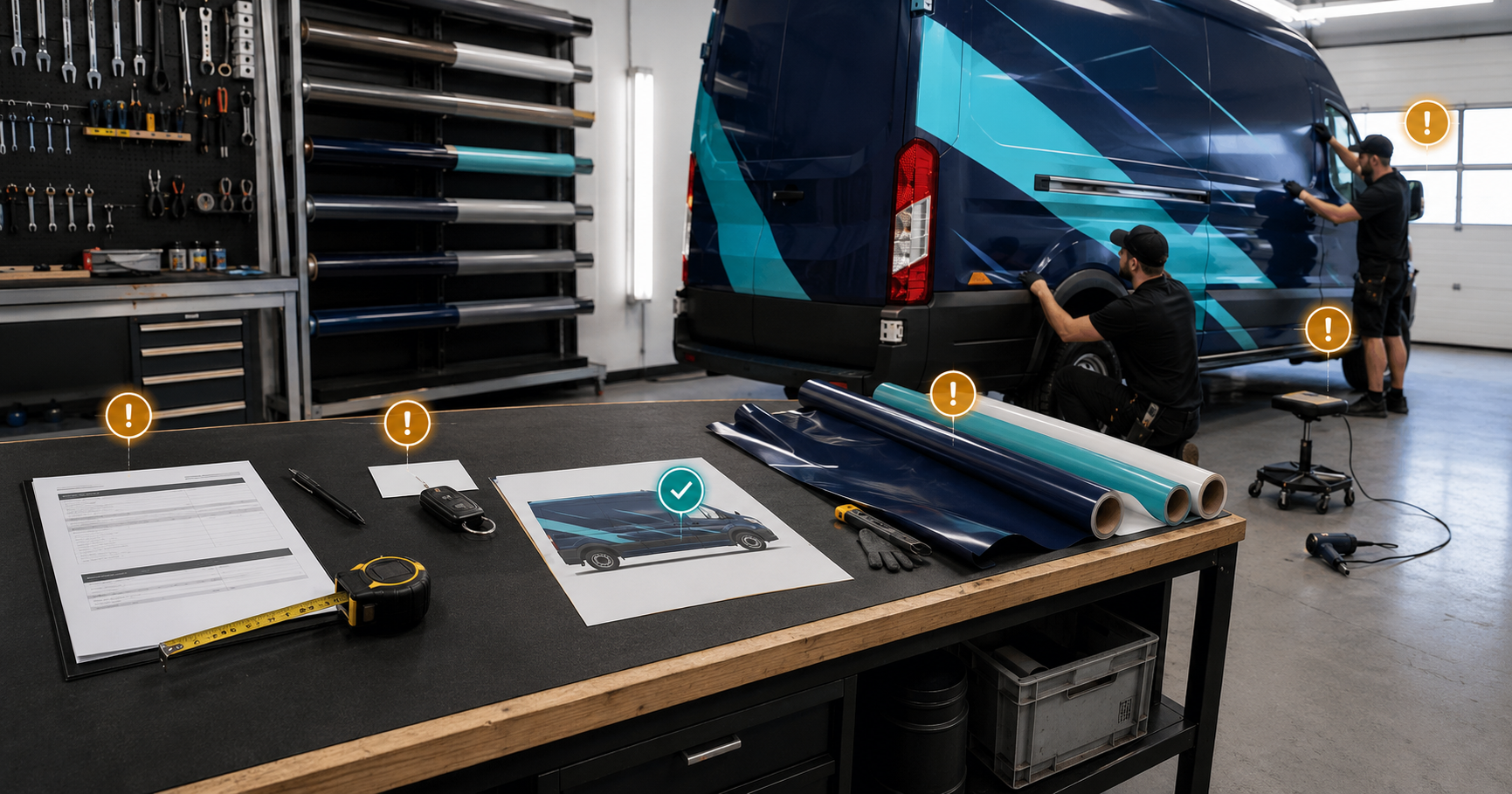
A vehicle wrap shop can have a full pipeline and still lose money before a single panel is installed.
The problem is often not lead volume or installation quality. It is the handoff between the quote, deposit, design approval, material order, and scheduled install. Small gaps at each stage compound: a vague quote absorbs unexpected labour, film is ordered before the customer commits, revisions disappear inside text threads, and a missed installation blocks a bay for days.
For wrap shops, profitability is protected long before the squeegee touches the vehicle. Here are the five most common quote-to-install profit leaks—and the systems that help close them.
Leak 1: The quote ignores installation complexity
Quoting only by vehicle size or square footage is fast, but it can hide the work that determines whether a job is profitable.
Two vehicles with similar surface area may require very different labour. Complexity can increase because of:
- Deep recesses, compound curves, bumpers, spoilers, and difficult edges
- Existing graphics, adhesive, contamination, or paint concerns
- Extensive disassembly and reassembly
- Colour-change coverage inside door jambs and visible returns
- Multiple design revisions or non-production-ready artwork
- Specialty finishes, printed graphics, laminates, or material combinations
- Limited access to the vehicle before the installation date
Manufacturer guidance shows why these details matter. 3M's Vehicle Preparation for Success Guide recommends inspecting and preparing the vehicle before installation, while Avery Dennison's vehicle wrap guidelines require a signed pre-inspection form as a condition of warranty. A quote that ignores vehicle condition and installation difficulty creates risk before production begins.
How to fix the quoting leak
Use a structured intake and pricing checklist rather than relying on memory. Start with a base price, then account for the factors that add labour, design time, material, or risk.
Your quoting process should capture:
- Vehicle year, make, model, and configuration
- Full, partial, commercial, or colour-change wrap
- Vehicle condition and existing film
- Design readiness and included revision rounds
- Removal, cleaning, disassembly, and reassembly requirements
- Film, laminate, finish, and production specifications
- Estimated installer hours and bay days
- Exclusions, assumptions, and change-order rules
OXMotive does not currently calculate wrap prices or complexity multipliers. A dedicated estimating tool or standardized pricing worksheet should handle the calculation. OXMotive can then keep the customer, vehicle, job notes, photos, and resulting work details connected so the installation team understands what was sold.
Leak 2: Material is ordered before the customer is committed
Film and print production create real costs before the installation starts. If the customer delays, changes direction, or disappears after material is ordered, the shop may be left carrying custom inventory that cannot easily be used elsewhere.
A verbal agreement is not the same as a committed job.
How to fix the deposit leak
Define a clear point at which the job becomes confirmed. Before ordering material or reserving multiple install days, require:
- A signed scope or accepted quote
- A booking deposit collected through your payment or booking provider
- Agreement to cancellation, rescheduling, and custom-material terms
- Confirmation of the vehicle, film, colour, and coverage
- A clear design-approval deadline
The deposit should be applied to the final balance and the policy should explain what happens when custom material has already been ordered.
OXMotive does not currently collect deposits directly. Shops can use their booking or payment provider for the transaction, then record the payment status or confirmation reference within the customer's job notes. This gives the team one place to see whether the project is ready to move forward.
Leak 3: Design approvals disappear inside text and email threads
Wrap design is rarely approved in one pass. Customers request colour changes, logo adjustments, phone-number corrections, repositioning, and new reference images. When those decisions are spread across email, SMS, social DMs, and personal phones, the shop can lose track of which proof is final.
That creates expensive mistakes:
- The wrong artwork reaches production
- An old phone number or logo gets printed
- Unapproved revisions consume design time
- The installer receives incomplete reference information
- The customer disputes a decision that was never documented clearly
How to fix the approval leak
Use one formal proofing process. Every version should have a revision number, date, and approval status. The approved proof should identify the exact vehicle, coverage, colours, copy, and design direction.
A dedicated online proofing tool is best for formal approvals and version control. Once approved, attach the final proof, reference photos, and relevant notes to the customer's job record.
OXMotive's customer and vehicle profiles, job notes, and photo and video documentation help keep the operational record together. It should support the approved design—not replace a formal proofing platform where signatures and version history are required.
Leak 4: A no-show blocks a multi-day install
A missed oil-change appointment may create an open hour. A missed full-wrap installation can create an empty bay for several days, leave installers underutilized, and disrupt every job scheduled behind it.
Wrap shops also face a preparation risk. A customer may arrive late, bring the wrong vehicle, or deliver a vehicle that is dirty, freshly painted, damaged, or still covered in old graphics that were not included in the plan.
How to protect the install schedule
Treat the install date as the final stage of a confirmation process, not a calendar entry made at the beginning.
Before the vehicle arrives:
- Confirm that the deposit and approved proof are complete
- Verify that the correct material is available
- Confirm the vehicle and expected drop-off time
- Send preparation instructions in advance
- Confirm how long the vehicle will remain at the shop
- Document removal, cleaning, paint, and damage expectations
- Require advance notice for rescheduling
OXMotive's job scheduling, technician assignments, customer records, and SMS updates help the team maintain visibility around the installation. Appointment reminders and self-service rescheduling should be handled by the connected booking provider based on the tools your shop uses.
For a deeper no-show prevention framework, read seven systems that reduce missed auto-service appointments.
Leak 5: The relationship ends when the vehicle leaves
A completed wrap is not necessarily a one-time transaction. Future opportunities may include:
- Wrap care or inspection
- Damage repair or panel replacement
- Removal at the end of the film's service life
- A new colour or complete rewrap
- Additional personal or fleet vehicles
- Updated branding, contact details, or campaign graphics
- Reviews, referrals, and portfolio permission
If the shop does not keep a usable customer and vehicle history, these opportunities depend on memory. Years later, the team may not know which film was installed, when the work was completed, which panels were repaired, or whether the customer operates other vehicles.
How to fix the follow-up leak
At completion, record the installation date, material and finish, coverage, warranty information, final photos, care instructions, and recommended follow-up window. Segment customers by wrap type, lifecycle stage, and fleet potential.
OXMotive centralizes customer and vehicle history, completed jobs, documentation, and communication records. That information gives the shop a reliable list for targeted follow-up. Automated marketing campaigns would still require a connected marketing or messaging platform, but the CRM record provides the data needed to reach the right customers at the right time.
Learn more about how wrap shops use a CRM to grow their customer base across multiple locations.
Build a quote-to-install workflow your team can follow
The strongest wrap shops do not rely on one person remembering every detail. They use clear stages and do not move a job forward until the requirements for that stage are complete.
- Inquiry: Capture the customer, vehicle, coverage, goals, timeline, and reference photos.
- Inspection and estimate: Assess condition and complexity before finalizing price.
- Commitment: Receive quote acceptance, deposit, and agreement to policies.
- Design: Manage revisions and obtain formal approval of the final proof.
- Production: Order or print material only after the job is approved to proceed.
- Installation: Confirm the vehicle, schedule, preparation, team, and bay capacity.
- Completion: Record final documentation, care instructions, and future follow-up.
Specialized estimating, payment, and proofing tools may still be needed. The goal is to connect their outputs to one customer and job record so the quote, design, production, and installation teams are working from the same information.
How OXMotive helps wrap shops protect the workflow
OXMotive gives wrap shops a central place to manage customer and vehicle profiles, jobs, technician assignments, service history, photos and videos, SMS updates, and business reporting.
Its mobile app helps teams capture vehicle condition and update jobs from the shop floor, while the web portal gives owners visibility into work across employees and locations.
OXMotive is not currently a dedicated wrap-estimating, payment-processing, proof-approval, or marketing-automation platform. Its role is to keep the operational record organized so important details do not disappear between the quote and the install.
Frequently asked questions
Why do vehicle wrap shops undercharge for jobs?
Undercharging often happens when quotes are based mainly on vehicle size and material coverage. Vehicle condition, recesses, curves, removal, disassembly, design revisions, specialty film, and installation time can add substantial complexity.
When should a wrap shop collect a deposit?
A deposit should generally be collected before custom material is ordered, production begins, or multiple installation days are reserved. The exact timing and refund terms should be documented in the shop's booking and cancellation policy.
How should a wrap shop manage design approvals?
Use a formal proofing process with version numbers, approval status, and a clear record of the final artwork. Attach the approved proof and supporting reference material to the customer's job record so production and installation teams use the correct version.
What information should be recorded after a vehicle wrap?
Record the installation date, vehicle, film and finish, coverage, warranty details, final photos, repair history, care instructions, and recommended follow-up window.
Can CRM software replace wrap estimating and proofing tools?
Usually not. A CRM organizes customer, vehicle, job, and communication records. Dedicated estimating, online proofing, payment, and marketing tools may still be needed, but their outputs should be connected to the same customer and job workflow.
Ready to keep every wrap job organized from customer intake to installation? Book a demo of OXMotive.
Subscribe to our newsletter today
Fresh insights and practical tips delivered every week.