.svg)
Vehicle Wrap Franchising in Mississauga: What It Takes to Standardize Quality Across Locations
Learn how Mississauga vehicle wrap franchises can standardize quoting, workflows, customer communication, and quality across every location.

.png)
Helping auto shops work smarter and grow.

A vehicle wrap franchise does not fail because one installer cannot lay vinyl. It fails when two locations quote the same job differently, promise different timelines, communicate differently, and deliver work that feels like it came from two separate brands. This guide shows Mississauga wrap shop owners how to build standards that hold when the owner is no longer standing beside every estimator and installer.
Mississauga supports wrap franchise growth when consistency is part of the offer
Mississauga gives a growing wrap business access to a deep commercial vehicle market. The Pearson airport corridor, nearby highways, warehousing and distribution activity, logistics operators, contractors, and service businesses put branded vans, trucks, and fleet vehicles on the road every day. The city's economic development office highlights the sector's local importance. Invest Mississauga's smart logistics overview explains the sector's local importance.
That demand can support more than one wrap location, but fleet customers also expose inconsistency quickly. A contractor with five vans expects the fifth vehicle to match the first. A logistics operator does not want a different approval process every time a unit visits another location. In Mississauga, standardization is part of the product the customer is buying.
Owners still preparing for their first expansion should first review this second-location growth roadmap for wrap shops. A franchise should reproduce a reliable location model, not rescue one that still depends on the owner for every decision.
Standardized quoting makes every location price the same job by the same rules
The first franchise leak usually appears at the quote. One estimator prices mainly by square footage. Another adds time for removals, damaged paint, curves, handles, sensors, roof access, or difficult disassembly. Both may be experienced, yet the same vehicle can receive different prices and expected margins.
Build a quote standard that separates base coverage from complexity. Define vehicle class, coverage level, material, design allowance, removal work, surface preparation, disassembly, installation difficulty, and rush requirements. Assign an approved price or multiplier to each variable. Estimators still use judgment, but they use it inside a controlled framework.
Use completed jobs to calculate the cost:
Average underquote per affected job x affected jobs per month x 12 = annual revenue lost to quote inconsistency
Review jobs where actual labour, material, or rework exceeded the quote and calculate the average gap. Do not rely on a generic benchmark.
OXMotive can turn the framework into structured, reusable quotes shared across locations. Required fields and consistent line items reduce memory-based pricing, while centralized records make it easier to compare what was quoted with what was scheduled and delivered.
One quote-to-install workflow stops locations from inventing their own process
A franchise manual that nobody uses will not create consistency. The working system must tell staff what happens next, who owns it, and what must be completed before the job moves forward.
A shared wrap workflow should cover lead intake, vehicle photos, measurements, quote preparation, deposit collection, design brief, proof approval, material ordering, installation booking, pre-install inspection, production, installation, final quality check, pickup, and follow-up. Each stage needs a completion rule. For example, material is not ordered until the deposit is recorded and the production proof is approved.
Small exceptions spread quickly. One location accepts approvals through personal texts. Another books a bay before collecting a deposit. A third orders material without confirming the install date. Soon the franchise has several informal operating systems, and the owner discovers the difference only when a customer complains or a bay sits empty.
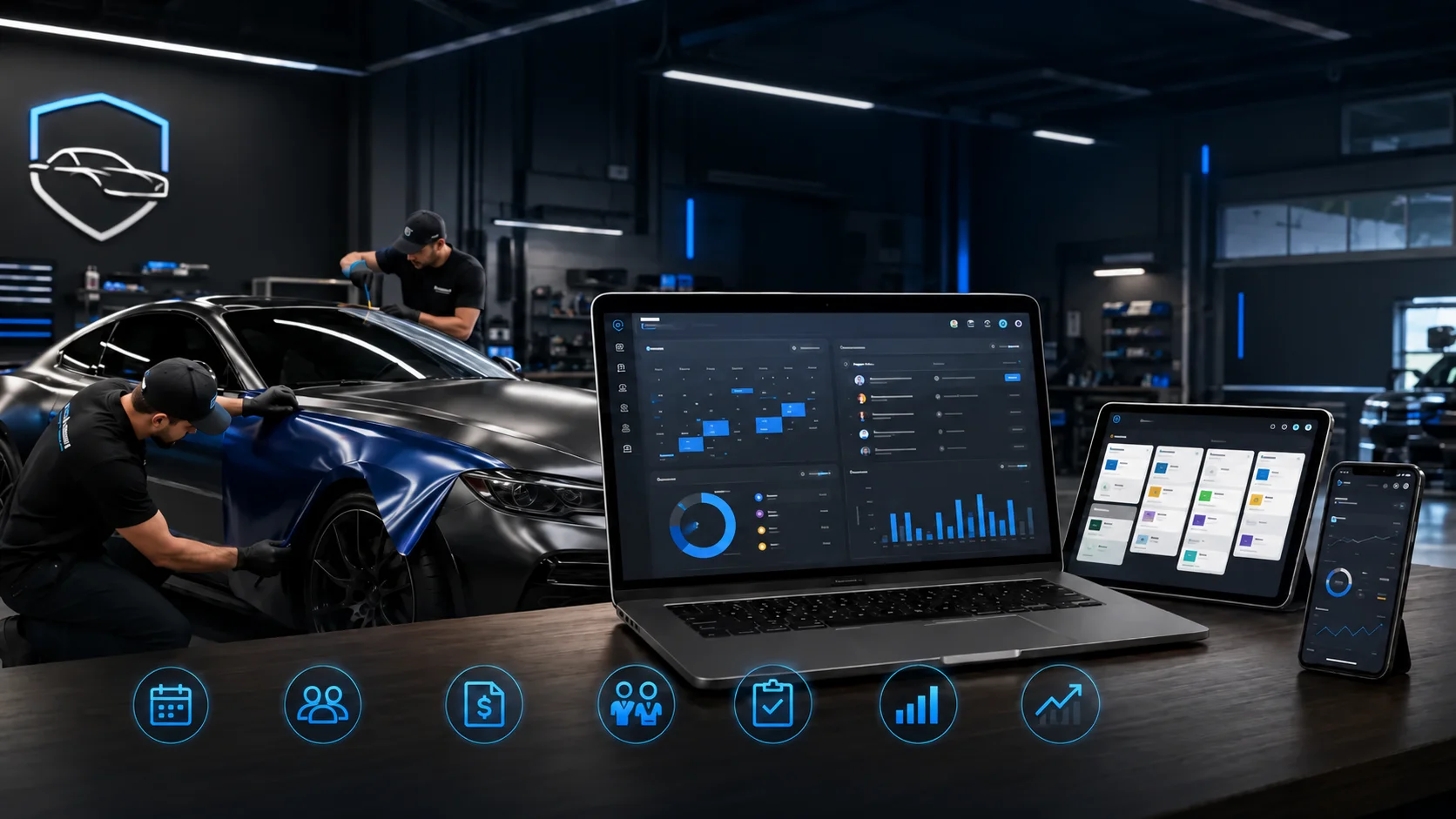
OXMotive gives locations a shared CRM workflow for quotes, deposits, appointments, reminders, and customer records. Its mobile app makes the process usable on the shop floor, where employees take reference photos, inspect vehicles, and update job status. For a broader overview, see OXMotive's guidance for wrap and tint studio operations.
Brand-consistent communication gives every customer the same experience
Customers judge consistency before they see the finished wrap. They notice how quickly the shop replies, whether the quote explains the work, how proof approval is handled, and whether install reminders arrive on time.
Create approved templates for repeatable moments: quote delivery, deposit request, design information request, proof approval, revision confirmation, appointment reminder, vehicle preparation, status update, pickup, care instructions, and post-install follow-up.
Keep two-way texting connected to the customer record. When design feedback, approvals, and timing changes live on personal phones, the next employee cannot see the decision trail. OXMotive's automated reminders and two-way texting let the franchise control core messages while keeping human conversations attached to the job. Local teams can respond naturally, but the important steps and brand voice stay consistent.
Centralized customer and fleet records keep repeat work consistent
A multi-location wrap business loses credibility when a returning fleet customer must explain the same specifications again. The franchise should know the material, colour references, artwork version, coverage, previous repairs, install date, contact preferences, and vehicles attached to the account.
Build records around the customer account, vehicle, and job history. Store approved proofs and reference photos with the relevant work. Record installation notes and post-install issues. If another location services the next vehicle, its team should start with the same information the original location had.
This matters in Mississauga's commercial market. A trades business may add a van months after its first wrap. A fleet operator may need a damaged panel replaced near the vehicle's current route. OXMotive centralizes customer records and service history so authorized teams work from one source of truth.
Documented quality standards make installation results auditable
Quality is difficult to franchise when it exists only in the founder's eye. An installer may think a job is ready while the owner would reject an edge, seam, alignment point, or finish detail. If acceptance is not documented, every location defines complete differently.
Turn quality into visible checkpoints. Define requirements for intake photos, surface condition, preparation, panel alignment, seam placement, edge finishing, trimming, reassembly, final inspection, and delivery photos. Specify required photo angles and close-ups. The checklist should identify what passes, what needs correction, and who signs off.
Also standardize approved vinyl families, laminates, production settings, and replacement policies. When an exception is necessary, record the reason and approval instead of allowing a silent substitution.
Use this franchise-location standardization audit:
- Quotes use approved vehicle classes, coverage rules, and complexity adjustments.
- Deposits and proof approvals are recorded before material is ordered.
- Appointments follow common bay-capacity and duration rules.
- Customer messages use current franchise templates.
- Vehicle, artwork, material, and installation details are stored centrally.
- Installers complete required intake and delivery photos.
- Rework, warranty issues, and complaints use consistent reason codes.
- Managers review the same location scorecard on a fixed schedule.
Audit completed jobs, not only written policies. Photos, timestamps, approvals, and job records show whether the location follows the standard under real production pressure.
Cross-location reporting finds quality drift before it damages the brand
Owners cannot manage a franchise by watching total sales alone. Revenue can rise while one location underquotes complex jobs, runs late, creates rework, or loses repeat customers.
Create one scorecard for every location. Useful measures include quote turnaround, quote-to-deposit progression, deposit status before booking, scheduled versus actual completion, material variance, rework by reason, warranty issues, customer response time, and repeat or fleet work. Define each measure once so locations cannot report the same activity differently.
Compare patterns, then investigate the process behind them. Repeated delays may start in estimating, bay capacity, proof approval, material ordering, or training. Rework may point to poor intake photos, preparation, materials, or final checks. Reporting should lead to a specific operational question, not a general argument about which location is better.
OXMotive's cross-location reporting and multi-location support give owners a shared view without requiring them to stand in every shop. Local managers remain accountable for corrections, while the system highlights exceptions that deserve attention. See how multi-location shop management connects location-level work with an owner-level view.
Franchise governance controls changes without slowing every shop
Standards become useless if anyone can change them, but the franchise stalls if every decision needs the founder. Separate fixed standards from controlled local decisions.
Fixed standards can include quote fields, materials, deposit rules, proof approval, core messages, quality documentation, and reporting definitions. Controlled local decisions can include staffing assignments, bay sequencing, community partnerships, and responses to unusual vehicle conditions within approved limits.
Assign an owner to every standard. One person approves pricing changes. Another owns production and installation requirements. Location managers train staff, review exceptions, and confirm corrective actions. Keep a revision record so every franchise knows which version is current.
Use a monthly operating review to examine exceptions. Which jobs bypassed the standard, and why? Was the rule unclear, the software configuration wrong, or the team under pressure? A strong franchise learns from real work without changing the customer promise from one location to another.
How standardized systems fit together across a wrap franchise
Vehicle wrap franchising works when quoting, deposits, approvals, scheduling, communication, customer history, quality control, and reporting operate as one system. Standardized quotes protect margins. Shared workflows keep jobs moving. Consistent communication builds trust. Documented inspections protect quality. Cross-location reporting shows where the process is drifting.
OXMotive can provide the common operating layer, but software cannot decide the standard for the business. Define how a good location works, configure that process in the CRM and mobile app, train against it, and audit completed jobs. That is how a Mississauga wrap brand can grow without losing the quality that made expansion possible.
Frequently asked questions about vehicle wrap franchising in Mississauga
Is Mississauga a good market for a vehicle wrap franchise?
Mississauga has a strong commercial base connected to Pearson airport, logistics, distribution, trades, and service businesses that operate branded vehicles. That creates potential for recurring fleet and replacement work, but the franchise still needs disciplined sales, production, and quality systems.
What should a wrap shop standardize before franchising?
Start with quoting rules, deposits, design approval, material specifications, scheduling, installation checkpoints, customer communication, and follow-up. If those steps depend on the founder's memory, the business is not ready to reproduce them reliably.
How do complexity multipliers improve vehicle wrap quotes?
Complexity multipliers make difficult work visible before the quote is sent. They help estimators price removals, damaged surfaces, difficult curves, disassembly, sensors, and rush work using the same approved logic.
How can a franchise owner audit wrap quality remotely?
Require standardized intake, process, and delivery photos plus a completed quality checklist. Review those records alongside rework, warranty, schedule, and customer feedback data to find patterns that need correction.
What does CRM software do for a multi-location wrap franchise?
A CRM connects customer records, structured quotes, deposits, appointments, messages, follow-up, and reporting across locations. It gives local teams the same process and gives the owner visibility without managing every job personally.
Subscribe to our newsletter today
Fresh insights and practical tips delivered every week.