.svg)
What Running Your Shop on Paper and Spreadsheets Really Costs You Each Year
Missed calls, no-shows, and manual admin quietly cost auto and appearance shops tens of thousands a year. Here is how to calculate your shop's real paper tax.

.png)
Helping auto shops work smarter and grow.
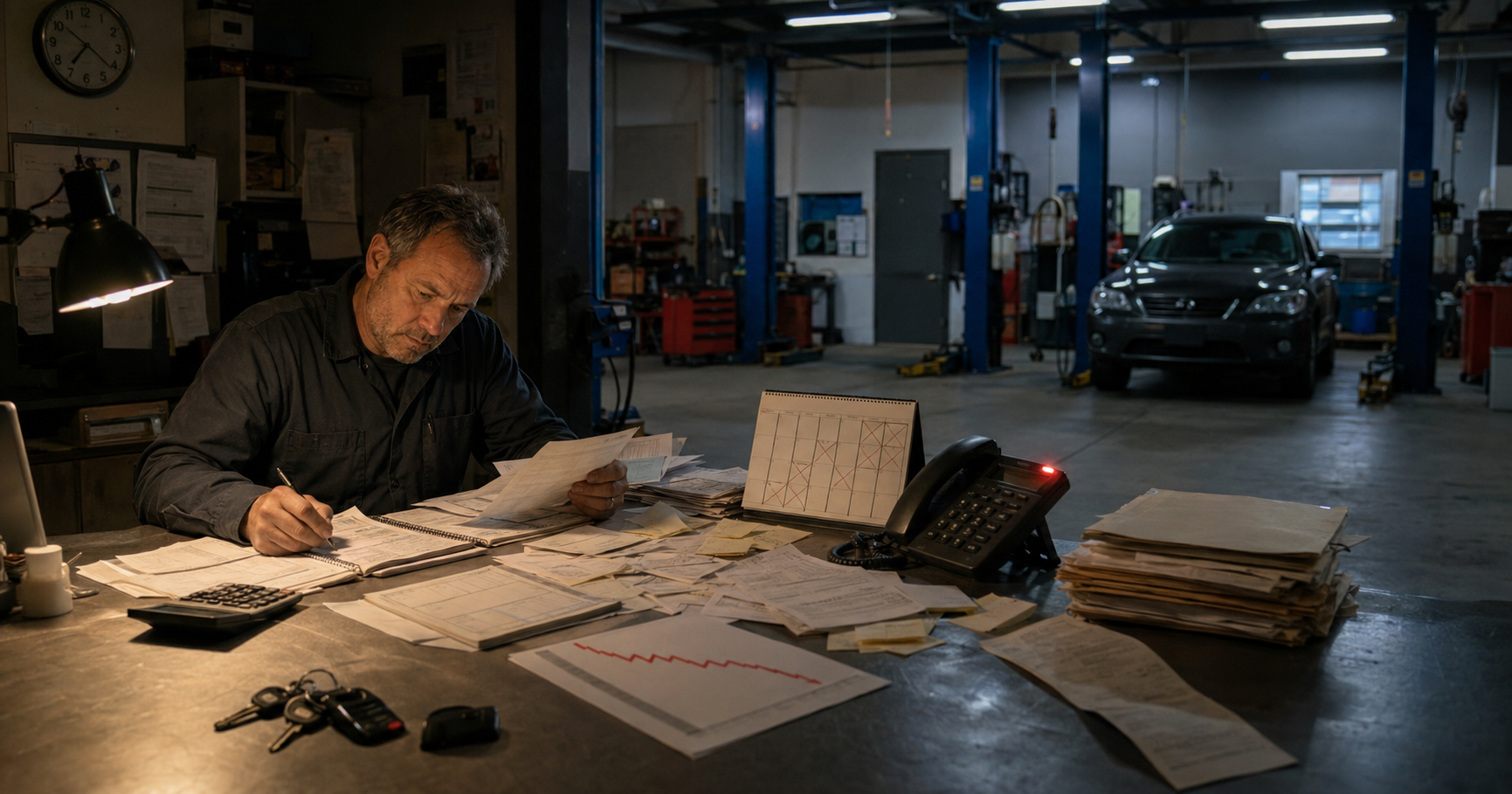
Most shop owners can tell you their labor rate and their parts markup off the top of their head. Almost none can tell you what running the shop on paper, spreadsheets, and sticky notes costs them every year. That number is real, it is large, and it is hiding in plain sight across three everyday leaks: missed calls, no-show appointments, and the hours you burn on manual admin. This guide shows you how to put a dollar figure on each one so you can decide whether the old way is actually costing you more than a system would.
Why "free" tools are the most expensive way to run a shop
Paper and spreadsheets feel free because there is no monthly bill. But the cost does not show up as an invoice. It shows up as a customer who called while you were under a car and never called back, a bay sitting empty because someone forgot their appointment, and the two hours every evening you spend chasing quotes and updating a spreadsheet instead of going home. None of those land on a statement, which is exactly why they go unmeasured for years. The first step to fixing a leak is measuring it, so let's put numbers to each one.
Leak #1: The calls you never answered
A ringing phone in a busy shop is a lead. When nobody picks up, that lead usually does not wait. Across small service businesses, studies consistently find that 20% to 40% of inbound calls go unanswered during business hours, and close to 100% after hours. The problem is not laziness. You are on a job, the counter is slammed, or two calls come in at once and there is one person to answer.
The part that hurts: research shows roughly 85% of callers who reach voicemail never call back, and most of them simply dial the next shop on Google. For a first-time caller, the lead is gone for good.
Here is a simple way to size it for your shop:
Missed-call cost = (calls per day) × (miss rate) × (working days) × (share that would have booked) × (average ticket)
Say you take 25 calls a day, miss 30% of them, work 300 days a year, and figure even a third of those missed callers would have booked at a $250 average ticket:
25 × 0.30 = 7.5 missed calls a day. Across 300 days that is 2,250 missed calls a year. If one in three would have booked, that is 750 lost jobs, and at $250 each that is $187,500 in work you never saw. Even if you halve every assumption to be conservative, you are still looking at tens of thousands of dollars walking to a competitor.
This is the leak a system closes fastest. When missed and after-hours calls automatically trigger a text back to the caller, the conversation stays with you instead of moving to the next shop. Two-way texting means a caller who could not reach you still books, reschedules, or asks their question, and it all lands in one place your team can pick up. OXMotive handles that automatically, so a call you physically could not answer does not become a customer you permanently lost.
Leak #2: The appointments that never showed
A no-show is worse than a slow day, because you planned around it. A technician is on the clock, a bay is reserved, and the car never arrives. Industry data puts the no-show rate for auto shops at roughly 15% to 20% of booked appointments. That means one in every five to seven scheduled jobs can simply evaporate.
To size your own exposure:
No-show cost = (no-shows per week) × (average ticket) × 52 weeks
At 4 no-shows a week and a $300 average ticket, that is $1,200 a week, or about $62,400 a year in work that was booked and then lost. One widely cited industry example, based on a shop running 40 appointments a week at a 15% no-show rate and $100/hour labor, puts the figure around $31,200 per bay per year. Whichever way you calculate it, the number is far bigger than most owners guess, because they only ever count the immediate lost job and never the annual total.
No-shows are overwhelmingly a forgetting-and-friction problem, not a bad-customer problem, which is why a system fixes most of them. The pattern that works is a confirmation when the appointment is booked, an automated reminder a couple of days out, and one more the day before, with an easy way for the customer to reply and reschedule instead of vanishing. Doing that by hand on your busiest days is impossible, which is exactly when no-shows spike. Automating reminders, confirmations, and reschedule links means the system protects your schedule even when your team is buried.
Leak #3: The hours you spend being your own office manager
The third leak is not lost revenue. It is your time, which is the one thing you can never bill twice. Owners of small service businesses spend a large share of every week on administrative work: writing quotes, chasing approvals, updating spreadsheets, sending reminders by hand, and copying the same customer details into three different places. Studies of small business owners find they lose 16 hours a week on average to administrative tasks, and that scheduling and coordination alone eats several of those hours every week.
Put an hourly value on your own time and the cost becomes obvious. If even 8 of those weekly hours are pure manual admin that a system would absorb, and your time is worth $50 an hour, that is $400 a week, or roughly $20,000 a year of your own labor spent on work that does not touch a single car. If those hours instead went into billable work or bringing in new business, the swing is larger still.
There is a hidden version of this cost too: spreadsheets are error-prone. A fat-fingered cell, a quote that never got followed up, a reminder that slipped means lost money that never even registers as a mistake. Centralizing customer records, quotes, scheduling, and follow-up in one system removes both the manual hours and the silent errors, because the information is entered once and everything downstream runs off it.
Add it up: your shop's annual paper tax
Run all three calculations with your own numbers and total them. Even a small single-bay shop, using conservative assumptions, tends to land in the tens of thousands of dollars a year once missed calls, no-shows, and admin time are counted together. A busier or multi-bay operation can clear six figures without much effort.
That total is what we'd call your paper tax: the amount the "free" way of running the shop quietly charges you every year. The reason it feels free is that it never arrives as a bill. It arrives as a competitor answering the call you missed, a bay you paid for sitting empty, and your evenings disappearing into a spreadsheet.
Once you have that number, the question changes. It is no longer "can I afford software," it is "can I afford to keep losing this much." A CRM and mobile app like OXMotive exists to convert those three leaks into recovered revenue and recovered time: missed calls become texted-back bookings, no-shows become confirmed or rescheduled appointments, and hours of manual admin collapse into automated workflows that run whether or not anyone remembers to trigger them. You can see the plans and pricing here.
How the pieces work together
None of these leaks is fixed by working harder, because working harder is what causes them. You miss calls because you are busy. You get no-shows because you did not have time to confirm. You lose evenings to admin because there is no one else to do it. A system fixes them by removing the dependence on someone finding a spare minute. Reminders send themselves. Missed calls text back on their own. Customer records, quotes, and follow-ups live in one place instead of your head and three notebooks. Start by calculating your own paper tax with the three formulas above, then decide which leak is bleeding the most, and close that one first.
Frequently asked questions
How much does running a shop on paper and spreadsheets actually cost?
It varies by shop size, but when you add up missed calls, no-shows, and manual admin time, even a small single-bay shop usually lands in the tens of thousands of dollars a year, and busier or multi-bay shops often exceed six figures. The cost is invisible because it never arrives as an invoice. It shows up as lost jobs, empty bays, and your own unbilled hours.
What percentage of business calls do small shops actually miss?
Studies of small service businesses consistently find that 20% to 40% of inbound calls go unanswered during business hours, and close to 100% go unanswered after hours. Around 85% of callers who reach voicemail never call back, so most missed calls become permanently lost leads rather than delayed ones.
What is a typical no-show rate for an auto or appearance shop?
Industry data puts auto shop no-show rates at roughly 15% to 20% of booked appointments, meaning one in every five to seven scheduled jobs can be lost. Most no-shows are caused by forgetting rather than bad intent, which is why automated reminders and easy rescheduling reduce them significantly.
How many hours a week do shop owners lose to admin?
Research on small business owners finds they spend around 16 hours a week on average on administrative tasks, with scheduling and coordination alone taking several of those hours. Putting an hourly value on that time usually reveals thousands of dollars a year spent on work that never touches a vehicle.
Will shop software actually pay for itself?
For most shops the recovered revenue from even one closed leak covers the cost of the software many times over. If a system recaptures a handful of missed calls and prevents a few no-shows a month, it typically pays for itself well before you account for the hours of admin time it also gives back.
Figures in this article reflect published small-business and automotive-industry benchmarks and are provided as planning ranges. Run the formulas with your own call volume, ticket size, and no-show count to estimate your shop's actual numbers.
Subscribe to our newsletter today
Fresh insights and practical tips delivered every week.